About Wurmbea dioica (R.Br.) F.Muell.
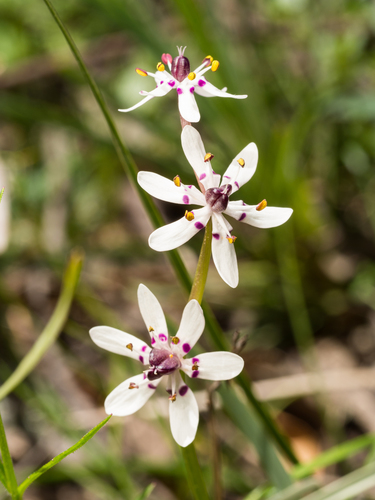
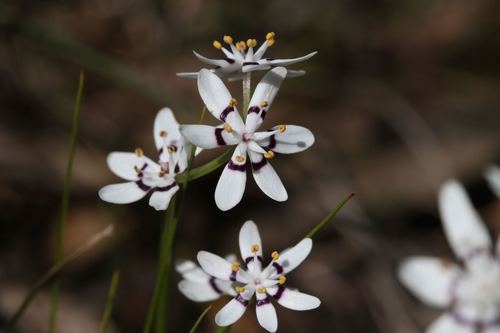
Wurmbea dioica (R.Br.) F.Muell. is an herb that typically reaches a height of 3.5–40 cm (1.4–15.7 in). It has three linear to thread-like or tapering leaves that measure 10–350 mm (0.39–13.78 in) long and 0.2–6 mm (0.0079–0.2362 in) wide, with a sheathing base at the bottom of each leaf. Individual Wurmbea dioica plants may produce only male flowers, only female flowers, or both male and female flowers; they sometimes also produce bisexual flowers. Each plant can bear up to fifteen flowers, and each flower has six elliptic white tepals that are 3.5–11.5 mm (0.14–0.45 in) long. Every tepal has a nectary band that ranges in color from purple to greenish or white, and extends from the tepal's base for one-quarter to one-half of the tepal's total length. The stamens are half to two-thirds as long as the tepals, and the anthers are about 1 mm (0.039 in) long with a red or purple color. Flowering occurs mainly from June to November, and the fruit produced is a capsule that measures 5–10 mm (0.20–0.39 in) long. This species is widespread and common across all six Australian states and the Australian Capital Territory, with no confirmed records from the Northern Territory. It grows in a wide variety of habitats. There are three accepted subspecies: subsp. dioica, the most common, which occurs in all eastern Australian states, South Australia, and the Australian Capital Territory; subsp. brevifolia, which is found in Victoria and South Australia and grows in drier locations than subsp. dioica; and subsp. alba, which is restricted to Western Australia, where it grows in winter-wet swamps and around granite rocks.