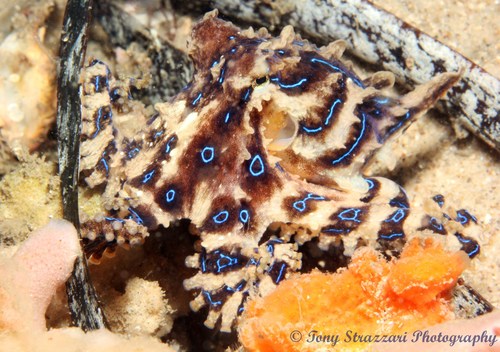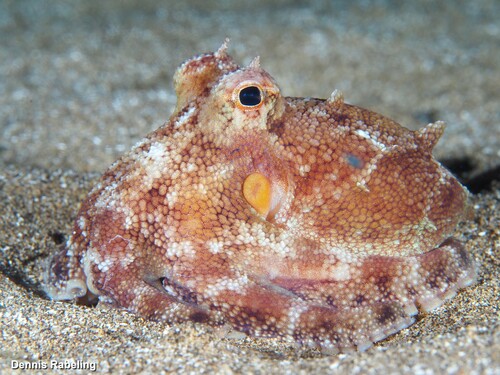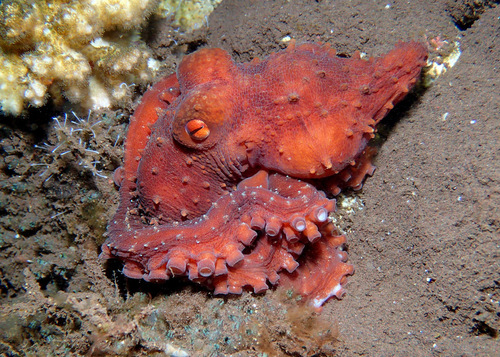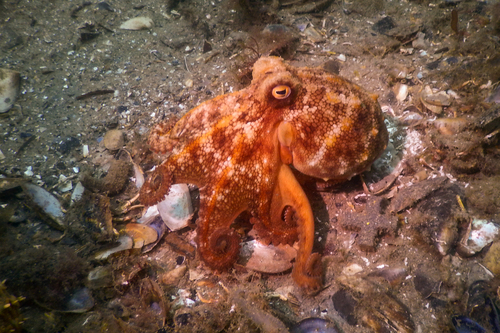
About Wunderpus photogenicus Hochberg, Norman & Finn, 2006
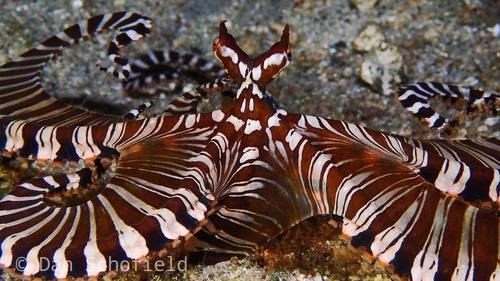
Tracking individual cephalopods over time and across distances is challenging for multiple reasons. Researchers have traditionally relied on natural injuries or scars to identify individual cephalopods, but this method does not work for long-term identification, as octopuses can regenerate limbs and heal relatively quickly. External tags are another tracking approach, but octopuses are able to remove these tags from their bodies, making the method ineffective. Tattooing is also an option, but it puts the organism at risk. This makes photo-identification the best method for tracking this species. The wunderpus (Wunderpus photogenicus) has naturally consistent body coloration and patterns, which can be used to identify individual animals. Photo-identification lets researchers identify and track individuals or populations without physically handling the animals. For photo-identification to work successfully, a species' body color and pattern must differ between individuals, and stay consistent over time. Each individual wunderpus has unique white markings set against a reddish-brown background, which makes photo-identification an ideal method for tracking them over time. The ability to track individual wunderpus or entire populations helps scientists study intraspecific behavioral interactions, survivorship, migration patterns, and produce population estimates. These observations and datasets improve our understanding of this under-documented species. The wunderpus is found in shallow waters ranging from Bali and Sulawesi northward to the Philippines and eastward to Vanuatu. A well-documented location popular with dive photographers is the volcanic sand plain near the Lembeh Strait. These soft-bodied octopuses are benthic creatures that live along bottom sediments in relatively shallow water, no deeper than 20 m (66 ft). Wunderpus prefer habitats with soft sediment substrates, which let them burrow under the substrate or other organisms to find shelter. Wunderpus population density can vary widely, ranging from up to 5 individuals per 25 m² (270 ft²) to densities so low that no individuals can be spotted. Male wunderpus have a relatively short but strong reproductive organ (penis). Their spermatophore storage sac is located sub-terminally in the mantle, and occupies approximately 50% of the mantle's length. The storage sac is broad and translucent, allowing spermatophores to be seen through its thin wall. The spermatophores are 'unarmed', and there are typically 25 to 30 spermatophores held in each translucent storage sac. Female wunderpus have a large sub-terminal ovary with 4 follicular folds. A single female produces around 2,000 mature small, stalked eggs per brood. The female carries her eggs in her arms, and typically dies shortly after her offspring hatch. Wunderpus hatchlings are swimmers that move through the water column using their tiny finger-like arms, rather than being benthic organisms. For mating, the male wunderpus mounts the female to insert his short hectocotylized arm into the female's mantle. In most other octopus species, the male's hectocotylized arm is longer, which allows more distance between the male and female during mating.