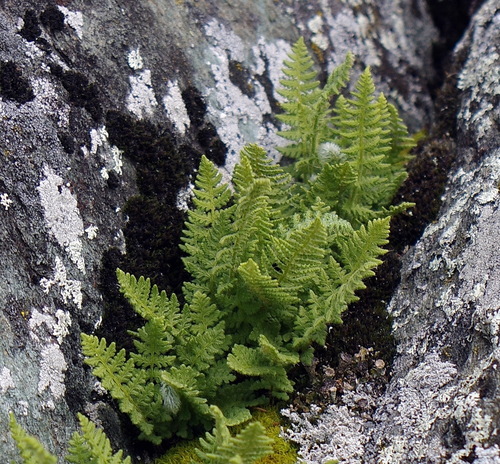
About Woodsia ilvensis (L.) R.Br.
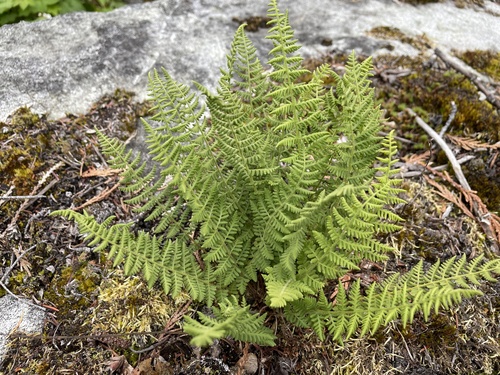
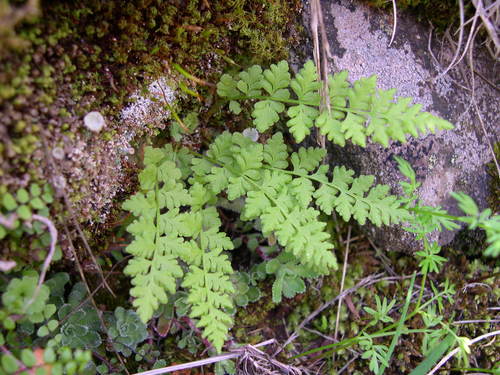
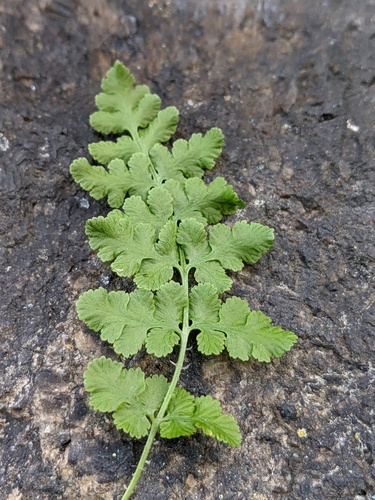
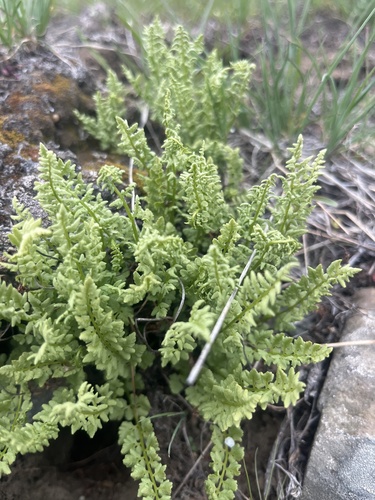
This species, known by the scientific name Woodsia ilvensis (L.) R.Br., typically has leaves around 6 inches long and 1 inch wide. Its leaves have stiff, erect pointed tips, and are divided into 12 nearly opposite, stemless leaflets. The underside of the leaves is covered in white woolly fibres that turn rusty brown as they age. This fern has a circumpolar distribution. It is most abundant in Scandinavia, the Ural and Altai mountains, and the eastern United States. It can also be found in Japan, Alaska, Canada, coastal Greenland, and various European locations including the Alps. In the United States, it is listed as Threatened or Endangered in Illinois, Iowa, and Maryland, and Presumed Extirpated in Ohio. It also occurs in West Virginia and North Carolina, and it is the most common Woodsia species found in the US. In the United Kingdom, its distribution is restricted to Angus and the Moffat Hills in Scotland, north Wales, and Teesdale and the Lake District in England. Fewer than 90 wild clumps of this species exist across the entire UK, where it grows at the edge of its natural range and is classified as Endangered. Because of this status, it became a protected species in the UK in 1975 under the Conservation of Wild Creatures and Wild Plants Act.