About Wollemia nobilis W.G.Jones et al.
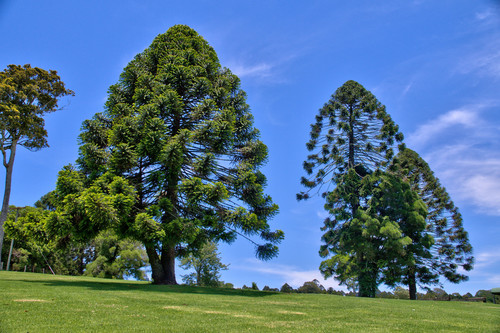
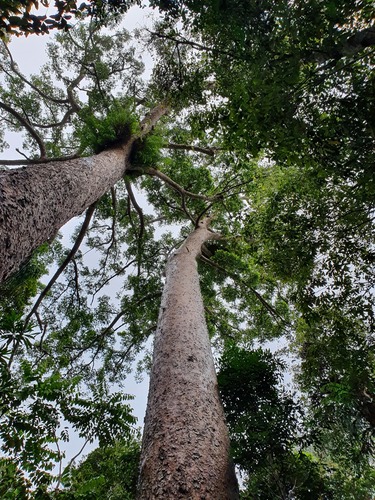
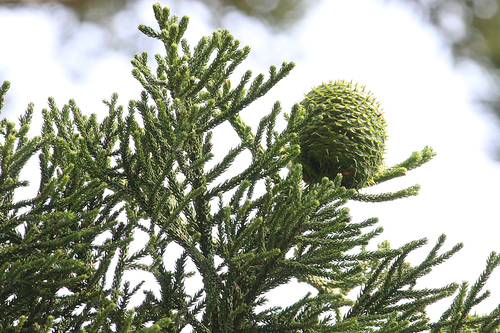
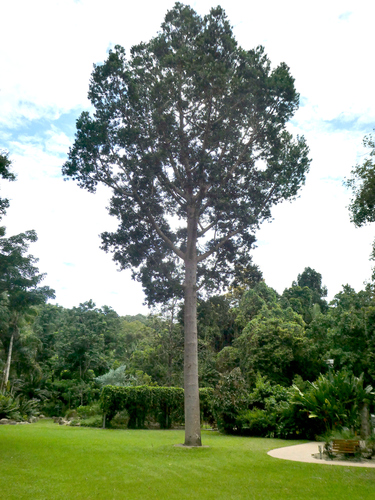
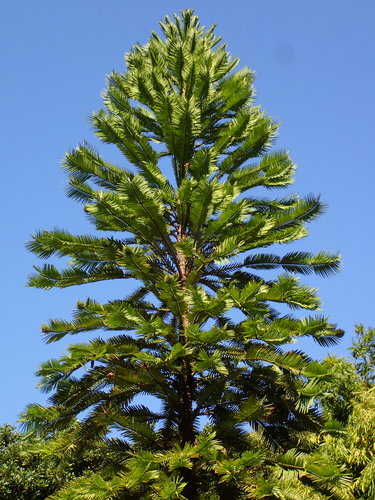
Wollemia nobilis is an evergreen tree that grows 25–40 m (82–131 ft) tall. Its dark brown, knobbly bark is very distinctive, and is often described as resembling the breakfast cereal Coco Pops. The tree coppices readily, so most specimens are multiple-trunked or grow as clumps of trunks thought to originate from old coppice growth; some clumps contain up to 100 stems of differing sizes. Its branching pattern is unusual: most side branches never produce further branching. After a few years, each branch either terminates in one or a sequence of male or female cones, and can continue bearing cones for up to around 12 years. New branches then grow from dormant buds on the main trunk. As trees mature, side branches often grow upright and develop into secondary trunks, which then produce new sets of side branches. This process creates the multi-trunked form seen in wild populations. The leaves are flat and linear, measuring 3–8 cm (1.2–3.1 in) long and 2–5 mm (0.079–0.197 in) broad. They grow in a spiral arrangement along the shoot but are twisted at the base to appear in two or four flattened ranks. As leaves mature, their color changes from bright lime-green to a more yellowish-green. Seed cones are green, 6–12 cm (2.4–4.7 in) long and 5–10 cm (2.0–3.9 in) in diameter. They mature around 18–20 months after wind pollination, and disintegrate at maturity to release seeds. The seeds are small, brown, thin and papery, with a wing around their edge that aids wind dispersal. Male pollen cones are slender and conical, 5–11 cm (2.0–4.3 in) long and 1–2 cm (0.39–0.79 in) broad, with a reddish-brown color, and they grow lower on the tree than seed cones. This species begins bearing cones at a young age: trees planted at Kew in 1997 produced their first cones in 2006, when they were 10–11 years old. Seedlings grow slowly, while mature trees are extremely long-lived; some of the oldest living individuals today are estimated to be 500 to 1,000 years old.
A propagation program has made Wollemi pine specimens available to botanical gardens, first in Australia in 2006, and later across the world. It shows potential as a valuable ornamental tree, suitable for planting in open ground or growing in tubs and planters. In Australia, potted native Wollemi pines have been promoted for use as Christmas trees. It is also more adaptable and cold-hardy than its limited native temperate-subtropical humid distribution would suggest, tolerating temperatures between −5 and 45 °C (23 and 113 °F). Reports from Japan and the United States note it can survive temperatures as low as −12 °C (10 °F). A grove of Wollemi pines planted in Inverewe Garden, Scotland, thought to be the most northerly successful planting to date, survived a recorded temperature of −7 °C (19 °F) in January 2010. It grows well in both full sun and full shade. Like many other Australian trees, Wollemia is susceptible to the pathogenic water mould Phytophthora cinnamomi, which may limit its potential use as a timber tree. The Royal Botanic Gardens in Sydney has published guidance for growing Wollemi pines from seed harvested by helicopter from wild forest trees. Most seeds that fall from cones are not viable, so seeds must be sorted to keep only plump, dark seeds. These sorted seeds are sown on top of seed raising mix and watered. After water drains through the mix, the pot is placed in a plastic bag and refrigerated for two weeks. After this stratification period, the pot is removed from the plastic bag and kept in a warm location that does not receive strong direct sun, while remaining consistently moist but not waterlogged, until the seeds germinate. Germination can take several months.