About Wilkiea hugeliana (Tul.) A.DC.
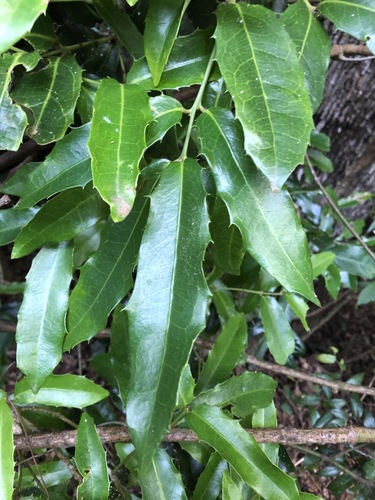
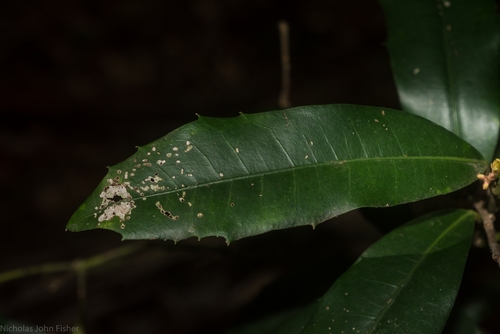
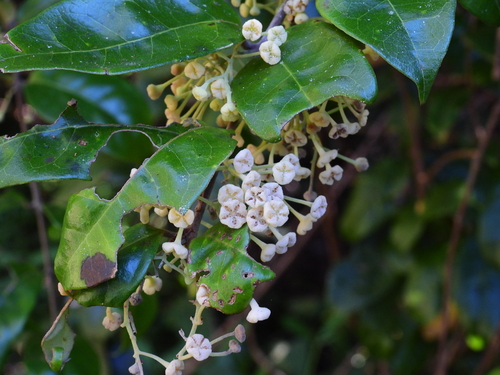
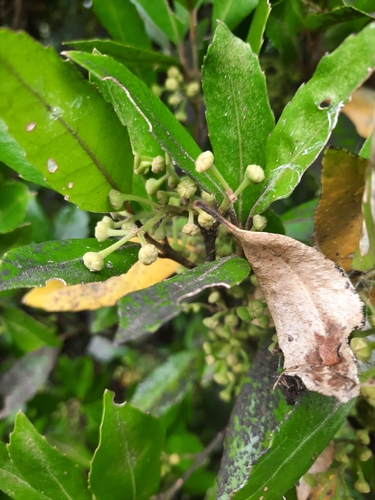
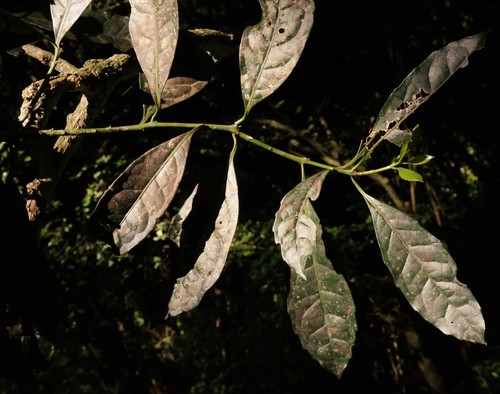
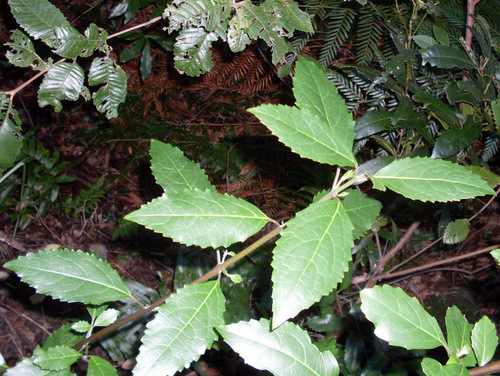
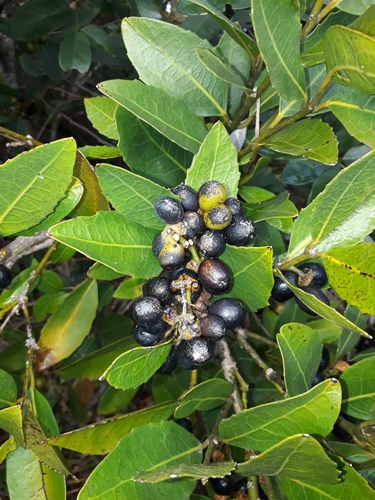
Wilkiea hugeliana is a tall shrub or small tree that usually grows between 1 and 8 meters (3 ft 3 in to 26 ft 3 in) tall, with a trunk diameter at breast height reaching up to 10 cm (3.9 in). Its leaves grow in opposite pairs, and are egg-shaped, oblong to narrowly elliptic, measuring 60 to 150 mm (2.4 to 5.9 in) long and 10 to 80 mm (0.39 to 3.15 in) wide, attached to stems by a petiole 5 to 12 mm (0.20 to 0.47 in) long. The leaves are leathery, with a prominent midvein and toothed margins. This species is dioecious, meaning male and female flowers grow on separate individual plants. Male flowers grow in groups of 7 to 9 in leaf axils, with the whole group measuring 20 to 25 mm (0.79 to 0.98 in) long. Each male flower is spherical, 2 to 4 mm (0.079 to 0.157 in) in diameter, borne on a pedicel 4 to 10 mm (0.16 to 0.39 in) long, and has 6 tepals plus 3 or 4 stamens. Female flowers grow in groups of 5 to 9, either at the ends of branchlets or in leaf axils, with the whole group measuring 25 to 30 mm (0.98 to 1.18 in) long. Each female flower is more or less spherical, 4 to 6 mm (0.16 to 0.24 in) in diameter, borne on a pedicel 5 to 10 mm (0.20 to 0.39 in) long, and contains 20 to 40 carpels. Flowering occurs between September and February. The fruit is a glossy bluish-black or glossy black drupe, with a pale yellow to orange receptacle.
The natural distribution of Wilkiea hugeliana, commonly called veiny wilkiea, extends from Mount Dromedary (36° S) near Narooma in southeastern New South Wales north to Maryborough (25° S) in southeastern Queensland. It grows in rainforest on coastal areas and inland ranges up to 900 m (3,000 ft) above sea level, and prefers volcanic soils. Research indicates that Wilkiea hugeliana is most likely pollinated by Thrips setipennis, a species of thrips. These thrips have been collected from both male and female flowers of the species.