About Wikstroemia indica (L.) C.A.Mey.
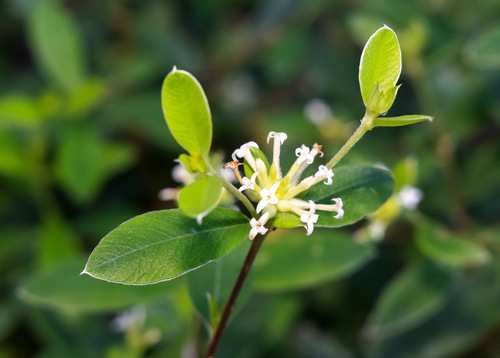
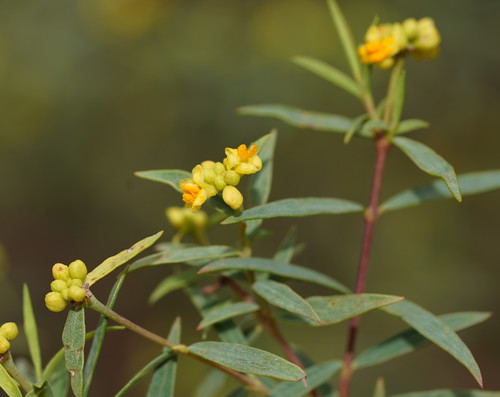
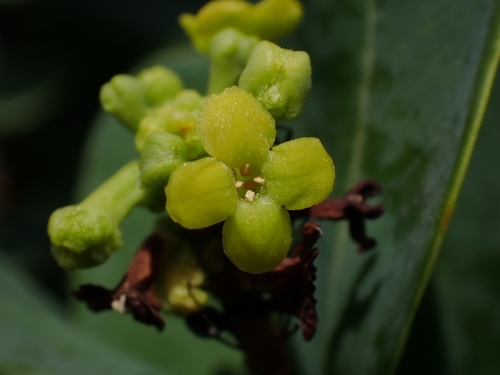
Wikstroemia indica, commonly called tie bush, Indian stringbush, bootlace bush, or small-leaf salago, has the Chinese name liǎo gē wáng (了哥王) and Vietnamese name dó liệt. It is a small shrub with glossy leaves, small greenish-yellow flowers, and toxic red fruits. This species grows in forests and on rocky, shrubby slopes in central and southeastern China, Vietnam, India, Australia, and the Philippines. W. indica is toxic. Poisoning from this plant causes dizziness, blurred vision, nausea, vomiting, abdominal distension, abdominal pain, and diarrhea. It is counted among the 50 fundamental herbs used in traditional Chinese medicine. As a traditional Chinese herb, it has long been used clinically in China as an antipyretic, detoxicant, expectorant, vermifuge, and abortifacient. In Vinh, hand-made paper produced from the phloem fibers of W. indica is used to package freshly caught fish. To make this paper, peeled bark of W. indica is harvested in Quỳnh Lưu, then shipped as dehydrated bales to Nghi Lộc. There, the fibers are rehydrated, scraped, cooked, beaten into pulp, bleached, and rinsed. The pulp is suspended in water and cast into sheets using large moulds made of mosquito netting and rebar, which are then left to dry in the sun. Once dry, the finished sheets are peeled from the moulds, folded into quarters, and sold to fishermen in Vinh. The paper helps keep fish fresh and prevents the fish from drying out during cooking.