About Wigandia urens (Ruiz & Pav.) Kunth
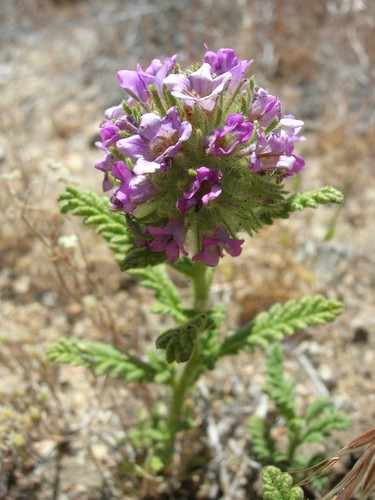
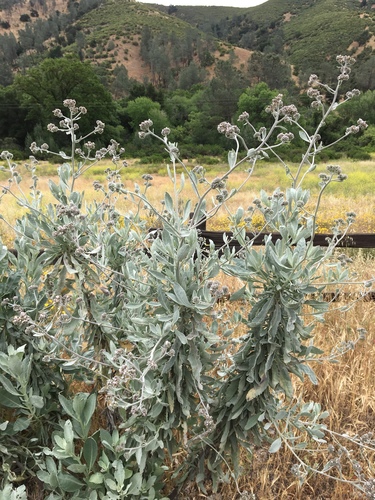
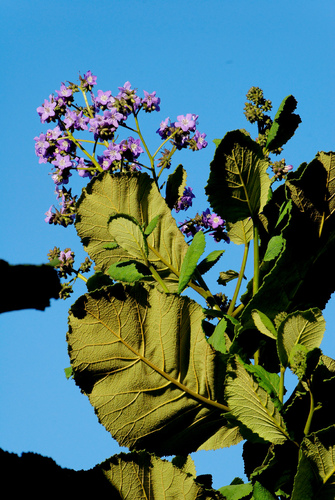
Wigandia urens (Ruiz & Pav.) Kunth is an erect shrubby plant that grows up to 6 meters tall. It can develop trichomes and urticating hairs, with petioles measuring 2.5 to 10 cm long. Its leaves are oval, 5.5 to 50 cm long and 3.5 to 37 cm wide. The flowers have calyx lobes 4 to 15 mm long, and broadly campanulate corollas that range in color from purple, blue, or whitish lilac, measuring 1.5 to 2.2 cm long. Stamens attach to the corollas for one quarter of their length; filaments are hairy, 1.2 to 1.5 cm long across the lower three quarters of their length. Anthers are slightly oblong, measuring 3 to 6 mm long. A variety of herbivorous insects are associated with this species, including the milpa grasshopper, conspicuous cricket, tree crickets, green peach aphid, Chichicastlera moth, and white-spotted owl moth, among others. It occurs in pine-oak forests, cloud forests, low deciduous forest, and xerophilous scrubland, at altitudes from 20 to 3000 m above sea level. Its native distribution includes the Mexican states of Sinaloa, Durango, Nayarit, Zacatecas, Jalisco, Colima, Aguascalientes, Guanajuato, San Luis Potosí, Michoacán, Querétaro, Hidalgo, State of Mexico, Mexico City, Tlaxcala, Morelos, Guerrero, Puebla, Veracruz, Oaxaca, and Chiapas, extends across all of Central America, and reaches as far south as Colombia and Venezuela. Specimens have been recorded in Australia and Africa, and the species is considered invasive in the western Himalayas, specifically in Uttarakhand state, India. The plant is commonly used for ornamental purposes, as well as ceremonial and religious purposes. It is also used as a traditional remedy to treat syphilis, rheumatism, and insomnia.