About Welwitschia mirabilis Hook.f.
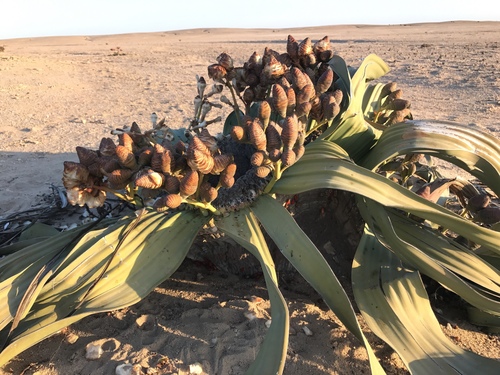
Welwitschia mirabilis Hook.f. After germination, the seedling produces two pink cotyledons that quickly turn green and grow to 25–35 mm (0.98–1.38 in) long. Next, two permanent leaves emerge opposite the cotyledons from the plant’s large, woody, crown-like stem. These ribbon-shaped leaves with parallel lengthwise veins grow rapidly and persist for the entire life of the plant. Shortly after the permanent leaves appear, the apical meristem dies, and all meristematic activity shifts to the periphery of the crown. Most individuals produce just two leaves (rarely three), which grow continuously across the full circumference of the crown and can reach up to 4 m (13 ft) in length. The disc-shaped crown widens as the plant ages, reaching up to 1 meter in diameter. The largest above-ground specimens are no more than 1.5 m (4.9 ft) tall, but the circumference of leaves lying in contact with sand can exceed 8 m (26 ft). The largest known recorded individual has a crown diameter of 2.77 metres (9.1 ft) and an overall leaf circumference of 8.7 m (29 ft). As the plant ages, weathering over years often causes the leaves to split into narrow ribbons and become frayed at the edges. It is difficult to determine the age of individual Welwitschia, and radiocarbon dating is the most common method used for this task. The species is exceptionally long-lived: many individuals are hundreds of years old, and the oldest may be as much as 2,000 years old. Welwitschia mirabilis is dioecious, meaning individual plants are either male or female. Both sexes produce cones that grow from the crown, and mature plants often develop hundreds of cones. Cones vary in color from green to salmon and multiple shades of brown. The cones produce nectar that attracts insects, most commonly flies, which carry the plant’s oval-shaped pollen as they move between plants. The species Probergrothius angolensis, commonly called the Welwitschia bug, is often found on Welwitschia, but it is not thought to act as a pollinator. It is not especially attracted to cone nectar and is usually found living on the plant’s leaves. Wasps and bees may also act as pollinators for Welwitschia, though this occurs infrequently. Due to producing only a single pair of permanent leaves, some researchers once hypothesized that Welwitschia is neotenic, and essentially represents a “giant seedling”. Later research found that the plant’s anatomy does not match the giant seedling hypothesis. Instead, its unusual morphology is more accurately explained by the early loss of its apical meristem, or “losing its head” at a young growth stage. Welwitschia mirabilis is endemic to the Namib desert. Its native range stretches over 1,000 km (620 mi) along the coast of Angola and Namibia, between the 14th and 24th southern parallels. This region is extremely arid: the coastal area receives almost no rainfall at all, and areas below the escarpment get less than 100 mm (3.9 in) of annual rainfall during the February to April wet season. Wild populations tend to grow in ephemeral watercourses, which indicates the species depends on groundwater as well as fog precipitation. Welwitschia mirabilis is grown from seed, which can be purchased from specialty seed dealers. Its seeds display orthodox seed behavior, meaning they can be stored for long periods at extreme humidity and temperature. Welwitschia seeds survive temperatures as high as 80 °C (176 °F) and as low as −20 °C (−4 °F) without significant damage. Seeds collected from the wild are often heavily contaminated with spores of the fungus Aspergillus niger, which causes the seeds to rot shortly after germination. The fungus infects Welwitschia’s developing cones early in their growth, with infection rates spiking when the ovule produces its sugary pollination drop. This contamination can render wild seeds nonviable before they fully develop. The fungicide tebuconazole may help control limited A. niger infection in Welwitschia seeds. Indigenous people sometimes eat the plant’s cones raw, or bake them in hot ashes. The Herero name for the plant, onyanga, translates to “onion of the desert”. Welwitschia mirabilis also appears growing from a sand dune on the coat of arms of Namibia.

