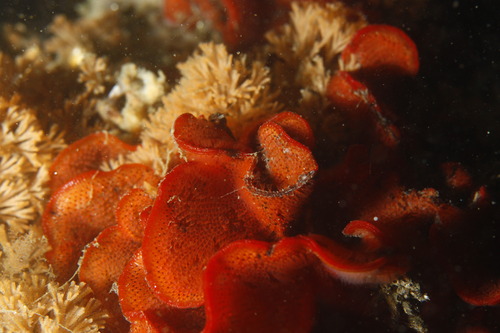
About Watersipora subtorquata (d'Orbigny, 1852)
Watersipora subtorquata starts as small encrusting patches when growing on flat surfaces. As patches grow, they buckle, fold, and overgrow themselves, forming leaf-like foliose structures in sheltered waters. These mature structures can reach up to 30 cm (12 inches) in height and 60 cm (24 inches) across. Colonies are typically some shade of orange or red, with variable amounts of black coloring. A colony is made of individual soft-bodied units called zooids. Each zooid is enclosed in a coffin-shaped, mineralized structural case called a zooecium. Zooecia are neatly arranged, radiating outward from the point where the colony first started. Each zooecium measures between 0.75 and 1.5 mm (0.03 to 0.06 inches) long, and 0.3 to 0.7 mm (0.01 to 0.03 inches) wide. The zooid's specialized feeding apparatus, called a lophophore, can protrude through an opening at the end of the zooecium, which faces away from the center of the colony. This lophophore has around twenty orange tentacles. A hinged lid called an operculum closes the aperture when the lophophore is retracted; this operculum is often black.
Watersipora subtorquata has a global distribution across warm seas. It remains unclear where this species originated, and whether the taxon represents a single species or a group of multiple species. It became permanently established in southern Australia by 1972, and in New Zealand 10 years later. Unusually, it had previously been recorded in Australia in 1947 and New Zealand in 1959; in both locations, the species initially thrived, but later declined and died out entirely. It is a fouling organism and is invasive on the Pacific coast of North America, where it is commonly found in harbors and estuaries along the coasts of California and Oregon. It can grow on a range of hard substrates including rocks, shells, buoys, pilings, docks, kelp, and ship hulls. It is tolerant to copper, so it can grow on ship hulls coated with copper-based anti-fouling paint. Once established, it can be overgrown by other fouling organisms that are less copper-tolerant.
The zooids of Watersipora subtorquata extend their lophophores into the water to catch small organic particles, which are their food source. Cilia on the tentacles move captured food particles toward the zooid's central mouth. Watersipora subtorquata is a hermaphrodite. Sperm are released into the water column, then drawn into other zooids to fertilize eggs. The resulting red larvae are initially brooded inside the host zooids' zooecia. When released into the sea, they settle quickly, undergo a dramatic metamorphosis, and develop into new colonies.

