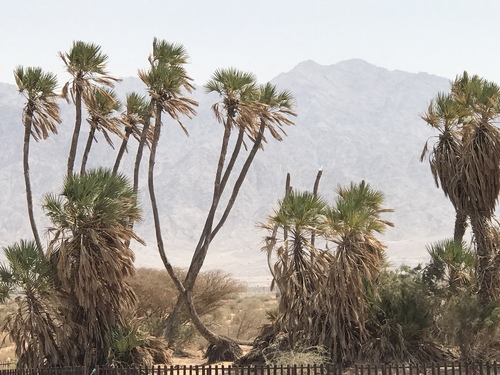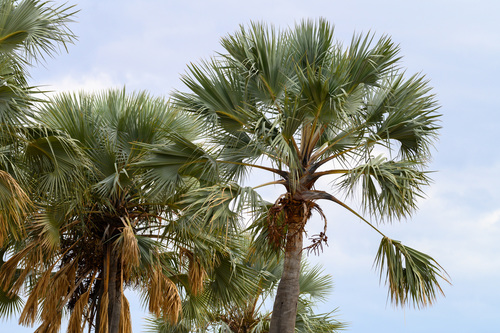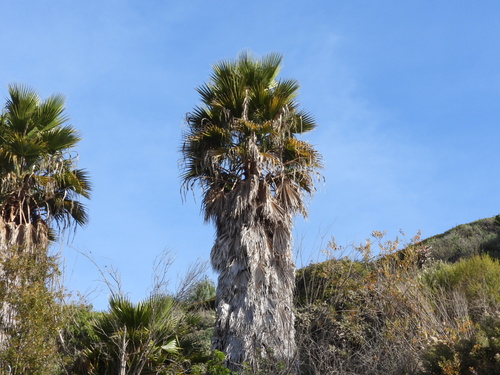
About Washingtonia robusta H.Wendl.
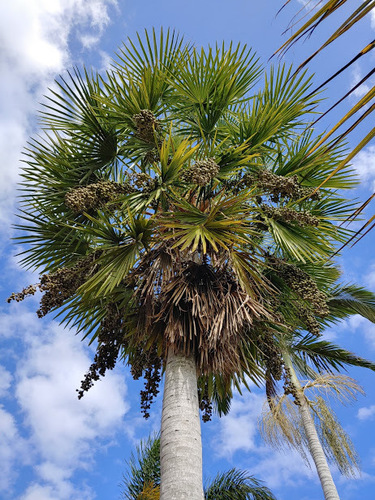
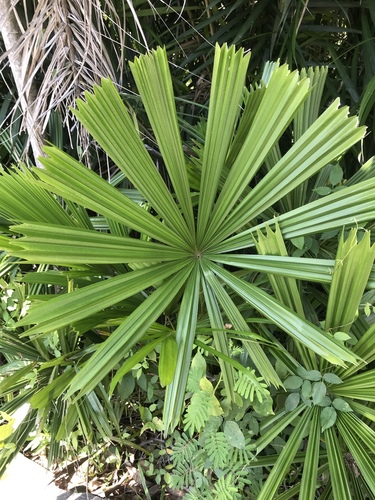
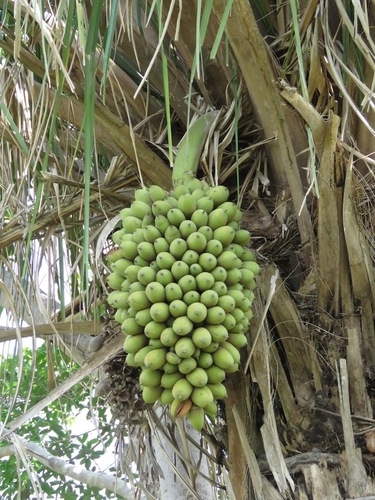
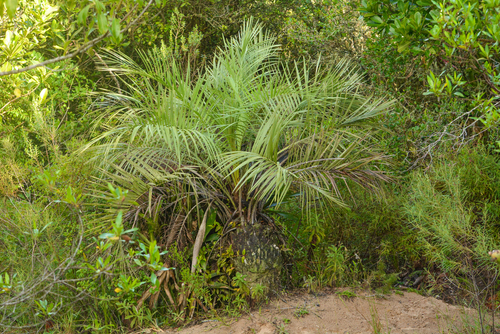
This taxon, previously treated as Washingtonia filifera var. robusta with the scientific name Washingtonia robusta H.Wendl., grows to 25 m (82 ft) tall, and rarely reaches up to 30 m (98 ft). Its leaves have petioles up to 1 m (3 ft 3 in) long that are lined with sharp thorns, and bear a palmate fan of leaflets up to 1 m (3 ft 3 in) long. The inflorescence grows up to 3 m (10 ft) long and holds numerous small, pale orange-pink flowers. The fruit is a spherical, blue-black drupe 6–8 mm (1⁄4–5⁄16 in) in diameter; it is edible, though it has very thin flesh. W. filifera var. filifera, which has a more northerly distribution in Arizona, Baja California, and California, is often confused with this taxon due to their very similar overall appearance. This palm is native to the Baja California peninsula and Sonora. On the Baja California peninsula, it occurs from the Sierra de La Asamblea and the Baja California desert south into the Vizcaino region, the Sierra de La Giganta, and all the way to the southern cape. In Sonora, it grows in canyons in the western half of the state, particularly in the palm oases of the Sierra El Aguaje north of Guaymas. Its distribution is relatively restricted, and the Sonoran population is suspected to be a relict population. It occurs in the lowest numbers within palm oases that it shares with two other more abundant palm species: Brahea brandegeei and Sabal uresana. Like the closely related Washingtonia filifera var. filifera (California fan palm), this palm is grown as an ornamental tree. Though very similar to the California fan palm, this Mexican fan palm has a narrower trunk that is typically wider at the base, grows slightly faster and taller, and is less cold hardy, tolerating temperatures down to about −8 °C (18 °F). Field research conducted on this taxon in its native habitat on the Baja California peninsula concluded that its potential longevity may exceed 500 years. Supporting research by Barry Tomlinson and Brett Huggett states there is "evidence for extreme longevity of metabolically functioning cells of considerable diversity in palm stems." Many of the iconic "sky duster" Mexican fan palms of Los Angeles that have survived development are documented in 19th century photographs. Mexican fan palm is normally grown in the desert Southwestern United States, in areas including California, Arizona, southern Nevada, extreme southwestern Utah and Texas. It is also cultivated in coastal areas of the South Atlantic states and the Gulf Coast, including southern North Carolina, coastal South Carolina, southern Georgia, and Florida. Along the Gulf Coast, Mexican fan palms grow from Florida's west coast westward to South Texas. Washingtonia × filibusta is a hybrid of this taxon and W. filifera var. filifera, with intermediate characteristics from both parent taxa, and notably greater tolerance of wet cold than its parents.