About Warszewiczia coccinea (Vahl) Klotzsch
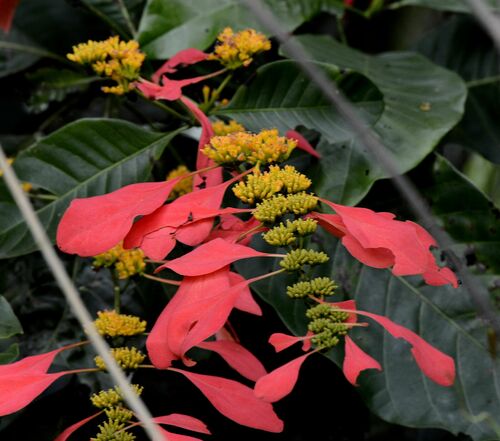
Warszewiczia coccinea (Vahl) Klotzsch, commonly called chaconia, wild poinsettia, pastora del monte, and pride of Trinidad and Tobago, is a flowering plant species in the Rubiaceae family. It is native to southern Central America from Nicaragua southwards, the southern West Indies, and northern South America extending south to Bolivia and central Brazil. It is the national flower of Trinidad and Tobago. This evergreen shrub or small tree reaches up to 6 meters in height. Its leaves can grow up to 60 cm long and 30 cm wide. The species is especially notable for its inflorescence, which is a verticillaster up to 50 cm long that holds up to a dozen clusters. These clusters feature bright red bracts that measure up to 7 cm by 5 cm, alongside small flowers with unnoticeable yellow petals. Its natural habitat is lowland forests and second-growth areas. It grows best at altitudes ranging from sea level up to 500 m, and is rarely found in areas above 500 m. This species is widely cultivated as an ornamental tree. The most commonly cultivated form is the cultivar Warszewiczia coccinea 'David Auyong', which has a double row of bracts. This cultivar comes from cuttings taken from a wild plant discovered along a roadside in Trinidad in 1957, and all double-bracted chaconia plants are propagated from cuttings of this single original individual.