About Wallago attu (Bloch & Schneider, 1801)
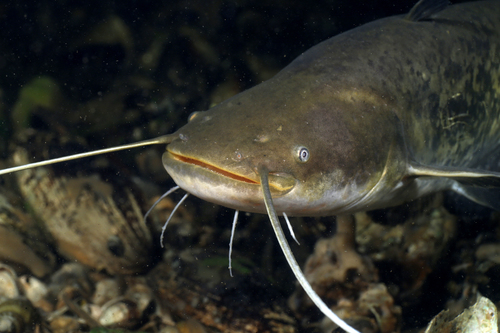
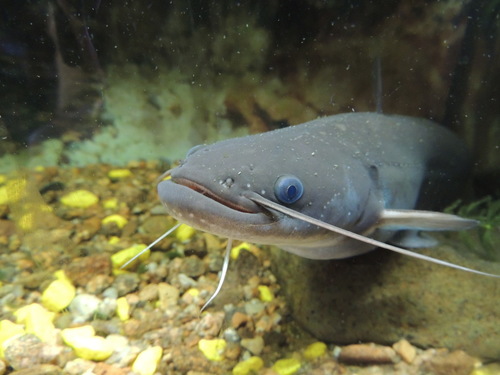
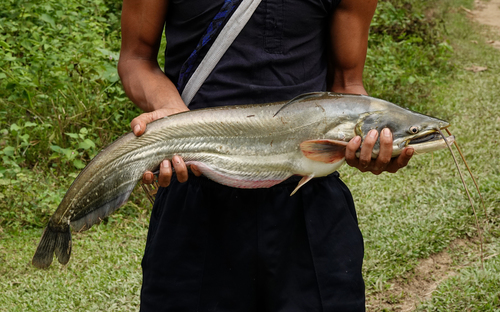
Wallago attu, commonly called boal or helicopter catfish, is a species of freshwater catfish in the family Siluridae. It is native to South and Southeast Asia, and has a disjunct (geographically disconnected) distribution: one population spans most of the Indian subcontinent, while the other is located in parts of Southeast Asia. This species can grow up to 1.1 m (3 ft 7 in) in length. It overlaps in range with the externally similar, much larger species Wallagonia leerii, and is often mistaken for it. It can be told apart from W. leerii by several traits: W. attu has a relatively longer, narrower head, a high and sharp dorsal fin (compared to W. leerii's lower, rounded dorsal fin), and eyes that sit above the mouth, while W. leerii's eyes are level with the mouth. This catfish has been used as food in Southeast Asia since ancient times. In Thailand, its meat is popularly used to make thot man (Thai fish cakes), just like meat from the clown featherback (Chitala ornata). Wallago attu is found across large areas of South and Southeast Asia, but its range is discontiguous, with a notable gap between the Indian subcontinent population and the population in mainland and insular Southeast Asia, making it a well-documented example of a species with disjunct distribution. On the Indian subcontinent, it occurs in all major rivers of India, Pakistan, Bhutan, Nepal and Bangladesh, including the Ganges, Indus, Narmada, Godavari, Krishna and Mahanadi, as well as on the island of Sri Lanka. To the northwest, its range extends past Pakistan into Iran and Afghanistan. To the east, it reaches as far as the Irrawaddy river basin in Myanmar. The second, Southeast Asian population occurs in Thailand, Laos, Cambodia, Vietnam, Malaysia and Indonesia, where it inhabits the Mae Klong, Chao Phraya and Mekong drainages, plus the drainages of the Malayan peninsula and the islands of Java and Sumatra. It is not found in Borneo, a fact ichthyologist Tyson R. Roberts considers surprising. The gap between the two populations is mostly made up of the Salween and Tenasserim River drainages in Burma, where W. attu does not occur, and the cause of this disjunct distribution remains unknown. As a large predatory fish, W. attu has a largely piscivorous (fish-eating) diet. Gut content analysis of specimens collected from India's Godavari river found that 90 to 95% of the food W. attu consumed was animal matter. The most common prey fish found in the stomachs of Godavari river W. attu are razorbelly minnows (Salmophasia phulo), ticto barbs (Pethia ticto) and perchlets (Chanda nama), all small species that reach a maximum length of about 10–12 cm (3.9–4.7 in).