About Wallabia bicolor (Desmarest, 1804)
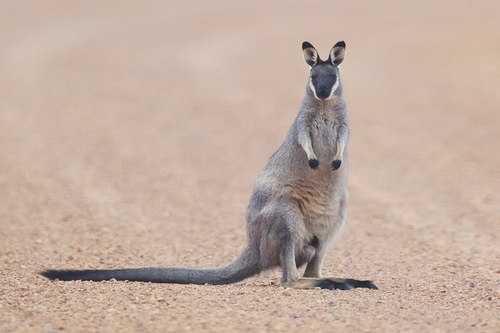
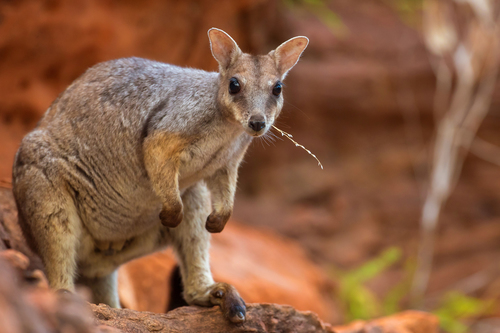
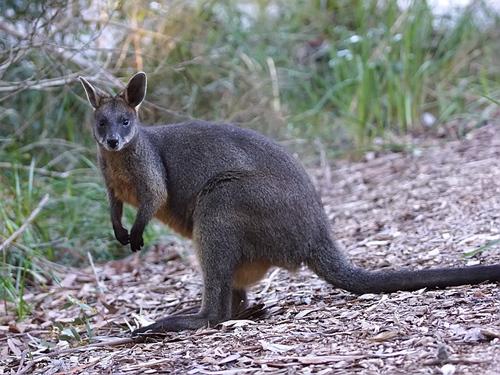
The specific epithet bicolor of Wallabia bicolor refers to its distinct colour variation. Like other macropods, it typically has a grey base coat, with a dark brown to black region on its back, and light yellow to rufous orange colouring on the chest. A light-coloured cheek stripe is usually present, and the extremities of the body are generally darker, except for the tip of the tail, which is often white. A rare 'golden' morph of the swamp wallaby occurs on North Stradbroke Island, South Stradbroke Island, and the adjacent mainland. This morph is yellow with a white muzzle, and its nose and paws may be either pink or black. The swamp wallaby's gait is different from that of other wallabies: it carries its head low and holds its tail straight out. Average body length (excluding the tail) is 76 cm (30 in) for males and 70 cm (28 in) for females. In both sexes, the tail is approximately the same length as the rest of the body. The average weight of males is 17 kg (37 lb), while females average 13 kg (29 lb). The wrist of the swamp wallaby has seven carpal bones, compared to eight in humans. The swamp wallaby is found from the northernmost areas of Cape York Peninsula in Queensland, down the entire eastern Australian coast, and extending to western Victoria and south-eastern South Australia. Its distribution has increased greatly over the past four decades, and has expanded overall since European settlement. Improvements in rabbit control appear to have contributed to this range extension. It lives in thick undergrowth in forests and woodlands, or shelters during the day in thick grass or ferns, and emerges at night to feed. It has been recorded in a range of diverse habitats including open farmland, mallee woodland, and sand-hills. Brigalow scrub in Queensland is a particularly favoured habitat of the species. Swamp wallabies reach reproductive maturity between 15 and 18 months of age, and can breed year-round. Gestation lasts 33 to 38 days, and produces a single young. The young is carried in the female's pouch for 8 to 9 months, and continues to suckle until it is around 15 months old. The swamp wallaby has an unusual form of embryonic diapause: unlike other marsupials, its gestation period is longer than its oestrous cycle. This timing allows female swamp wallabies to overlap two pregnancies, and can gestate both an embryo and a fetus at the same time. Females ovulate, mate, conceive, and form a new embryo one to two days before the birth of their full-term fetus. As a result, females are continuously pregnant throughout their reproductive life. The swamp wallaby is notable for having a unique sex-chromosome system different from that of most other therians, the subclass that includes marsupials and placental mammals. Females have the typical XX chromosome pair seen in other therians, but males have one X chromosome and two Y chromosomes that do not share sequence homology. This chromosome system is thought to have formed through a series of chromosomal fusions over the past 6 million years.