About Wahlenbergia stricta (R.Br.) Sweet
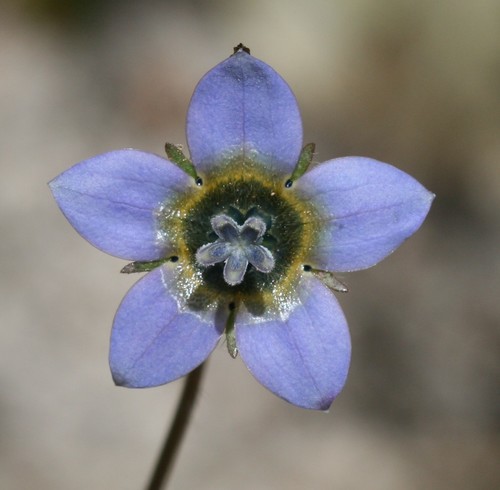
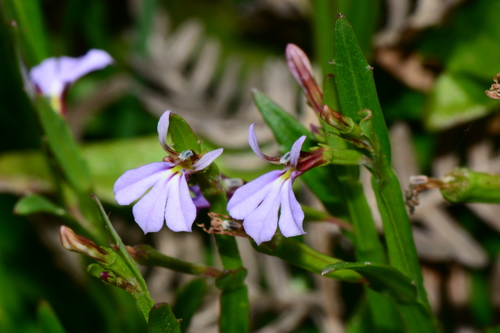
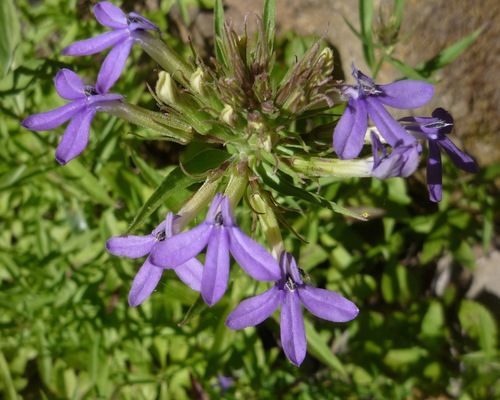
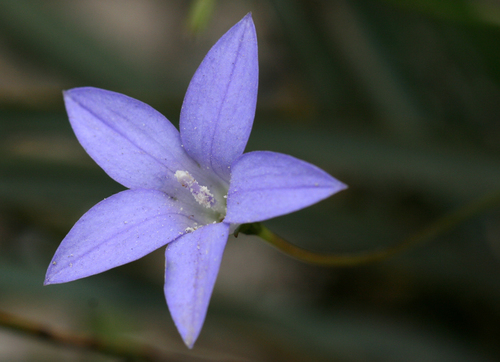
Wahlenbergia stricta, commonly known as Australian bluebell, tall bluebell, or austral bluebell, is an Australian wildflower belonging to the Campanulaceae family. It is the most commonly encountered species within the Wahlenbergia genus. This species grows in every Australian state, but is not found in the Northern Territory. It is often found growing alongside roads, where it benefits from extra water runoff. Wahlenbergia stricta is a perennial herb that flowers mainly in spring or summer, producing pale blue, bell-shaped flowers. Its leaves are long and linear, measuring 5–70 millimetres (0.20–2.76 in) in length. The five-petalled flowers grow erect on long, slender stems, and reach around 6–20 millimetres (0.24–0.79 in) in diameter. This plant forms thin, carrot-shaped tubers. Australian bluebell is generally easy to propagate, either by division or root cutting. Its seeds are extremely fine, and resemble black powder. Seeds germinate readily within a few weeks, and are best sown directly into tubes or growing cells. This direct sowing is recommended because both the seed and young plant are very small, making separation and pricking out difficult. A number of common cultivars exist, with flower colors ranging from a saturated blue similar to hex color #00f through to white. Double-flowered forms are also available. To preserve the unique characteristics of a cultivar, propagation must be done through vegetative methods such as division or cuttings. Once established, W. stricta is very hardy. Potted plants can be left to dry out completely, with the above-ground growth dying back to leave only the tuber, yet the plant will reshoot when water becomes available. It grows well hardy in a wide range of soil types, from sand and gravel to clay and humus.