About Wahlenbergia pygmaea Colenso
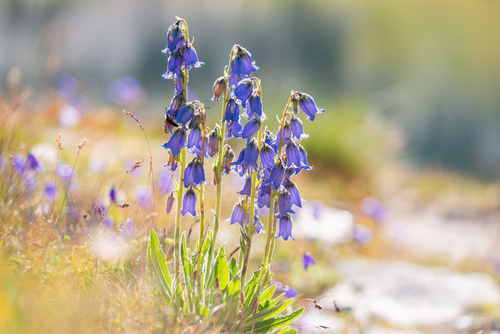
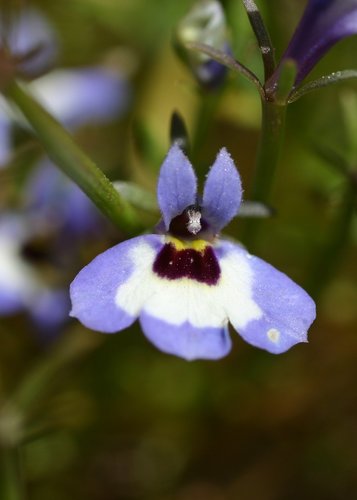
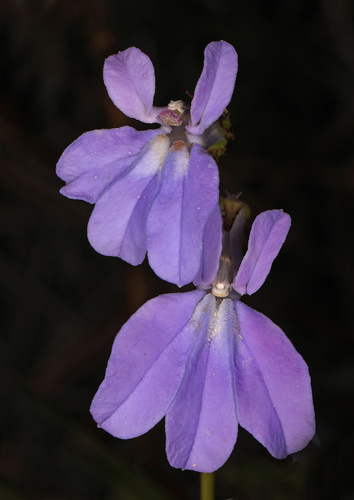
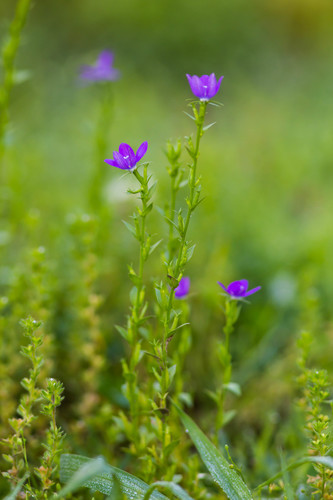
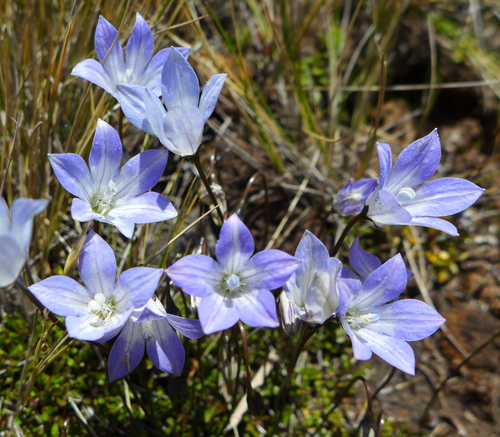
Wahlenbergia pygmaea Colenso is a perennial, rhizomatous herb. It forms a dense cluster of low-growing leaves close to the ground, and its white and blue flowers emerge from a short stem. Its bell-shaped flowers are wider than those of the similar related species Wahlenbergia albomarginata, which is found in the South Island. In his original description of the species, William Colenso noted that this is a peculiarly striking little plant, from its uniform size and pleasing appearance, with a rather large drooping bell-flower springing from its little squarrose moss-like tuft of leaves. Two of its recognized subspecies can be easily distinguished: subspecies tararua has rosettes of serrate, flat, dark-green leaves, while subspecies drucei has crimped, bright-green leaves. Wahlenbergia pygmaea is restricted to the North Island of New Zealand. It has three disjunct populations, each classified as a separate subspecies: subspecies drucei occurs near Taranaki, subspecies tararua grows in the Tararua Range, and subspecies pygmaea is found in the central North Island on the central plateau near Tongariro. This species grows above the treeline in montane and alpine environments. On the North Island, its range is effectively limited to volcanoes, the central plateau, and the more southerly Tararua Range. It can survive at lower elevations in the Rangipo desert, an arid region formed by the eruption of Taupō Volcano, than it does in other subalpine areas across the island. It grows in tussock grassland, on rocky ground, and on old lava fields. It is occasionally washed down to riverbeds by water flows, where it can successfully grow on stony ground. The flowers of Wahlenbergia pygmaea are pollinated by insects. Its roots form associations with arbuscular mycorrhiza. Some sources suggest ungulates avoid eating this species, but one study of red deer and sika deer recorded that the deer do consume W. pygmaea. Seeds matching this genus have been recovered from coprolites of various moa genera, which originally suggested the extinct moa ate this plant. However, the study that recovered these seeds examined species from the South Island, indicating the seeds most likely belonged to plants from the Wahlenbergia albomarginata complex instead. Vehicle disturbance appears to increase the population coverage of W. pygmaea when compared to other co-occurring plant species.