About Wachendorfia thyrsiflora L.
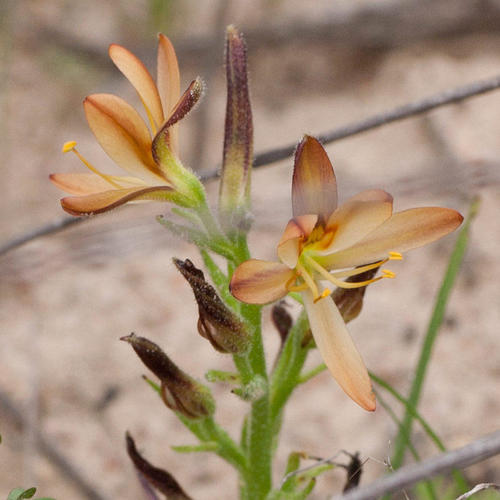
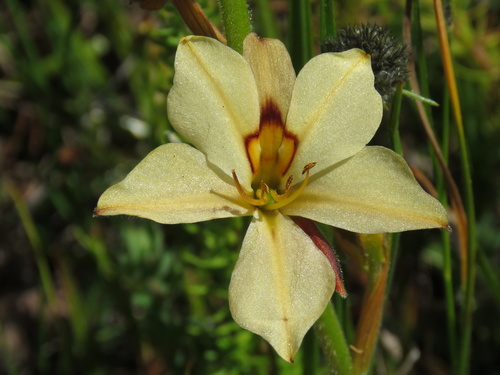
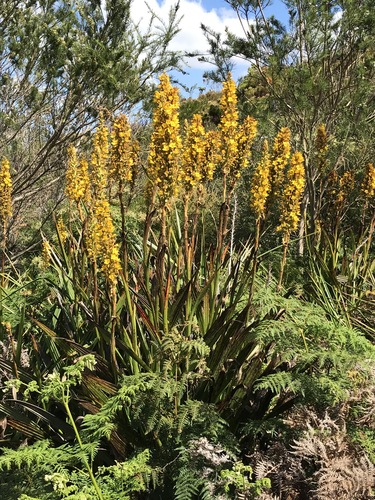
Wachendorfia thyrsiflora, commonly called the marsh butterfly lily, is a perennial herbaceous plant that reaches 0.6–2.5 m (2.0–8.2 ft) in height. It grows from an irregular, roughly cylindrical rootstock up to 15 cm (5.9 in) long; the rootstock is sheathed by overlapping leaf bases and produces new roots from its nodes. Its leaves are evergreen, upright, strap- to lance-shaped, deeply pleated, firm, hairless, and grow up to 90 cm (35 in) long and 8 cm (3.1 in) wide; leaves on younger plants are often less than 5 cm (2.0 in) wide, and most leaves are shorter than the plant’s flowering stem. The robust, upright flowering stem can be up to 2.5 m (8.2 ft) long and up to 1.5 cm (0.59 in) thick at its base. It has many soft hairs up to 4 mm (0.16 in) long near the base, which gradually change to 1 mm (0.039 in) glandular hairs toward the top of its flowering branches. The inflorescence is a dense cylindrical panicle up to 60 cm (24 in) long and 20 cm (7.9 in) wide, with many regularly spaced branches up to 10 cm (3.9 in) long along the top half of the stem; inflorescences on younger plants are often more open. Each branch rarely holds more than 7 flower buds, and the branches do not divide further. The persistent bracts are lance-shaped, 1–4 cm (0.39–1.57 in) long, dry, brown, papery, and have recurved tips. Each flower is zygomorphic, with six spade-shaped golden yellow tepals that are 12–28 mm (0.47–1.10 in) long and 8–14 mm (0.31–0.55 in) wide. The upper three tepals often have light to dark markings near their base that act as nectar guides. The central upper tepal is shorter and narrower than the other tepals, with a slightly recurved tip, and the upper five tepals overlap. Tepals may sometimes have a row of evenly sized, evenly spaced orange hairs along their edges. Filaments are 15–20 mm (0.59–0.79 in) long (about one quarter the length of the tepals) and spread widely. They are topped with anthers that measure 1.2–2.0 mm (0.047–0.079 in) long and 0.5–1.0 mm (0.020–0.039 in) wide. At the center of each flower is a yellowish superior ovary 2–3 mm (0.079–0.118 in) high and 1–2 mm (0.039–0.079 in) in diameter. A 13–18 mm (0.51–0.71 in) long style sits atop the ovary, and is noticeably angled to either the right or left, opposite two of the stamens. After fertilization, the ovary develops into a three-chambered capsule approximately 1 cm (0.39 in) high and 0.7–1 cm (0.28–0.39 in) in diameter. The seeds are densely hairy, kidney-shaped to oval, and up to 5 mm (0.20 in) long. The base chromosome count for this species is 15 (n=15). The marsh butterfly lily is distributed from the Olifants River Valley between Clanwilliam and Citrusdal in the Western Cape of South Africa, south to the Cape Peninsula, inland as far as the Franschhoek Mountains, and east along the south coast to Humansdorp in the Eastern Cape. Like all species in the genus Wachendorfia, marsh butterfly lily flowers are enantiomorphic: individual plants have styles that bend sharply either to the right or to the left. In both morphs, one of the three stamens deflects to the same side as the style, while the other two curve in the opposite direction. This arrangement is thought to be a mechanism that improves cross-pollination and increases genetic diversity. Because the anthers and stigma are located far from the nectar, which sits at the merged bases of the three upper tepals, smaller insects including honey bees cannot act as effective pollinators. Adequately sized pollinators such as carpenter bees are rarely observed visiting marsh butterfly lilies, so the pollination biology of this species remains unknown. The hard seeds float on water, which is likely an adaptation for water dispersal. W. thyrsiflora grows at altitudes from sea level to approximately 1,200 m (3,900 ft), in permanently moist habitats such as stream banks and seeps. It flowers in spring, and blooms can often still be found through summer, likely because the species does not experience water stress in its permanently moist growing environment. It is classified as a least-concern species. In cultivation, the marsh butterfly lily is easy to grow, and is especially well-suited for moist locations in full sun or light shade. The plant remains evergreen if water is available year-round, but becomes dormant in summer if conditions dry out. It grows rapidly, and can flower well for multiple years without needing to be replanted. It does not survive severe frosts, but tolerates temperatures down to −1 °C (30 °F), and possibly down to −7 °C (19 °F) when grown in a sheltered spot. No pests or diseases are known to affect this species. Wachendorfia thyrsiflora can be propagated both by seed and by dividing the rootstock. Seeds are best sown in autumn in deep seedling mix, and should be kept permanently moist. Seedlings are ready to transplant after three years, and will begin producing flowers in their fourth year. Large plants are best divided after flowering in early summer, and replanted immediately.