About Wachendorfia paniculata L.
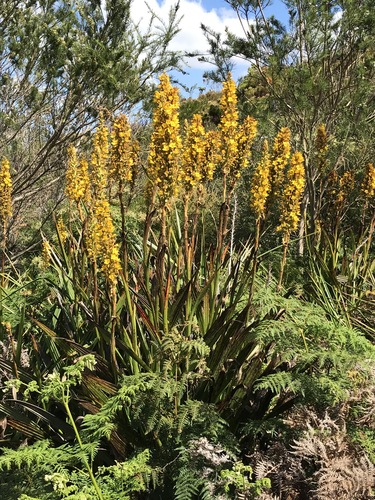
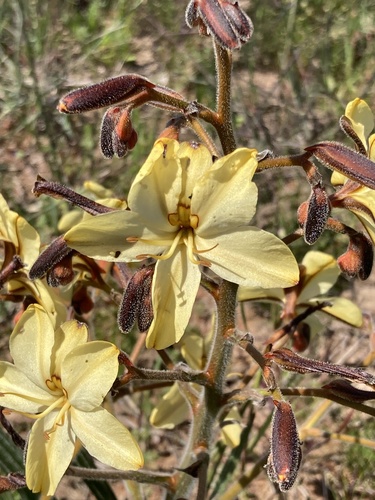
Wachendorfia paniculata, commonly called Koffiepit, is a perennial herbaceous plant that reaches 10–90 cm (3.9–35.4 in) in height. It grows from a roughly egg-shaped red rootstock that can be up to 5 cm (2.0 in) in diameter. Its leaves are dull to yellowish green, shaped linear to narrowly lanceolate or broadly sickle-shaped, and measure 1–7 mm (0.039–0.276 in) wide by 5–35 cm (2.0–13.8 in) long. Each leaf has three veins, and may be either hairy or hairless. New leaves grow annually during the winter half of the year, and die back once the plant releases its seeds, allowing it to survive the dry, hot summer. The flowering stem is densely covered in short, simple hairs, may occasionally reach 1 m (3.3 ft) in height, and is 3–15 mm (0.12–0.59 in) in diameter. The inflorescence is a lax or dense panicle made up of 5 to 20 scorpioid cymes, each holding up to seven flowers. Bracts at each branching point are 5–50 mm (0.20–1.97 in) long; they are dry, brown, and papery in texture when the plant is in flower, partially or almost fully enclose the base of the branch, and end in a long tapering point with concave edges that is often recurved. The flowers are mirror-symmetrical, slightly scented, and have a perianth of six tepals in shades of apricot, orange, or pale to bright yellow. Tepals measure 13–31 mm (0.51–1.22 in) long by 4–16 mm (0.16–0.63 in) wide, with an average size of 21×10 mm; they sometimes have a row of evenly spaced, equal-length hairs along their margins. The lower three tepals are free, and the lower central tepal is often wider than the others. The upper central tepal is often shorter, narrower, and curved at the tip, with brownish hairs on its back that match the hairs on the pedicel. The upper three tepals often have dark markings, and are fused together at their base, where two nectaries are located. The three stamens are two-thirds to three-quarters the length of the tepals, and spread widely apart. The anthers at the tip of the stamens are 2–3 mm (0.079–0.118 in) long and 0.8–1.0 mm (0.031–0.039 in) wide. The style is noticeably shifted to either the right or left, positioned opposite two of the three stamens, and measures 15–21 mm (0.59–0.83 in) long, which is equal to the length of the shortest stamen. The fruit is a sharply three-lobed capsule about 1 cm (0.39 in) high and 0.5 cm (0.20 in) in diameter. Each of the three chambers holds one spherical brown seed around 2 mm (0.079 in) in diameter, covered in coarse hairs. The base chromosome number for this species is 15 (n=15). Koffiepit is distributed from Nieuwoudtville in the southwest of South Africa's Northern Cape province to Port Elizabeth on the Eastern Cape province coast. It grows most often on sandy soils formed from weathered Table Mountain Sandstone, but can also occur on alluvial sands, granitic soils, and clay formed from Malmesbury shales. It grows at altitudes from sea level up to approximately 1,700 m (5,600 ft). It can be found in permanently moist shales, as well as on moderately to very dry soils in fynbos growing on both acid and alkaline sands, and may also occur in strandveld and renosterveld. It mostly flowers in young vegetation that has regrown within several years after the last fire, likely because it prefers open vegetation. The arrangement of the style shifted to one side, and two of the three stamens shifted to the opposite side, is thought to be an adaptation that improves cross-pollination. Koffiepit is classified as a least-concern species, because its population has a stable trend.