About Wachendorfia brachyandra W.F.Barker
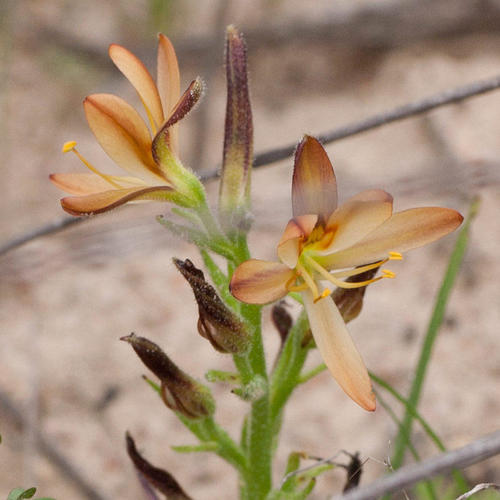
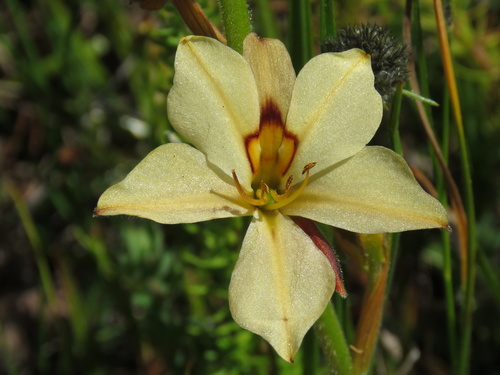
Wachendorfia brachyandra, commonly called the short-stamen butterfly-lily, is a perennial herbaceous plant that reaches 10–65 cm (3.9–25.6 in) in height. It grows from a small, globose to oval rootstock 0.5–2 cm (0.20–0.79 in) in diameter, and dies back during dry, hot summers. Its leaves are linear to lance-shaped, straight or often sickle-shaped, growing up to 70 cm (28 in) long and 3.5 cm (1.4 in) wide. The leaves are hairless, dark to yellowish green, and grow either upright or spreading. The flowering stem is roughly 3 mm (0.12 in) in diameter, covered in short glandular hairs, and is often less than 40 cm (16 in) high. Flowers are arranged in a lax, simple, rarely compound panicle, with 6 to 17 flowers per peduncle. Peduncles and pedicels are slender; peduncles are short near the tip of the inflorescence, while those at the base can grow much longer, up to 20 cm (7.9 in) long. Bracts are covered in dense soft hairs, grow up to 8 cm (3.1 in) long, are mostly dry, brown, and papery. They are oval to elongated with parallel sides and a pointed tip, almost completely enclose the pedicels, and do not have recurved tips on lower bracts. The zygomorphic perianth is made of six light apricot to yellow tepals 12–20 mm (0.47–0.79 in) long and 4–14 mm (0.16–0.55 in) wide, arranged in two whorls of three. Dark markings appear on the upper three tepals. The uppermost tepal is smaller than the others and only slightly recurved. Tepal margins only rarely have a row of evenly spaced, equally long hairs. This species is unique among Wachendorfia for having three clustered (not spreading) stamens that are only 6–14 mm (0.24–0.55 mm) long, roughly half the length of the tepals. Its anthers are 2.0–2.5 mm (0.079–0.098 in) long and 0.5–1.0 mm (0.020–0.039 in) wide. The style is also short, at 7–12 mm (0.28–0.47 in) long, and only slightly curved sideways. The fruit is a dry three-lobed capsule about 5 mm (0.20 in) wide and 8–10 mm (0.31–0.39 in) long. The seeds are spherical, about 2 mm (0.079 in) in diameter, and covered in coarse hairs. This species is found on the west coast of the Western Cape province of South Africa, ranging from Saldanha in the north to the Cape Peninsula in the south, and inland as far as Franschhoek. It grows in seasonally moist sandstone or granite soils at altitudes between 50–650 m (160–2,130 ft), in regions where most precipitation falls during the winter half of the year. It most often occurs in the following vegetation types: Boland Granite Fynbos, Cape Flats Sand Fynbos, Peninsula Granite Fynbos, Saldanha Granite Strandveld, Swartland Alluvium Fynbos, Swartland Granite Renosterveld, and Swartland Silcrete Renosterveld. It is currently classified as a vulnerable species.