About Vultur gryphus Linnaeus, 1758
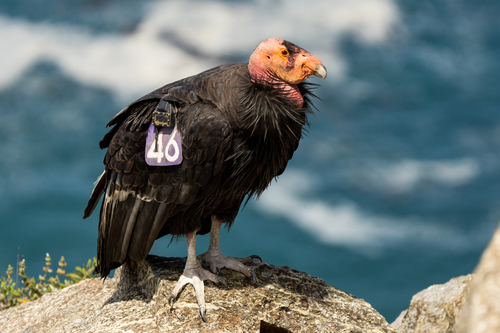
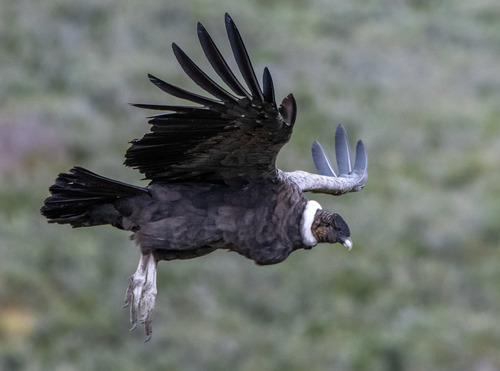
Andean condor (Vultur gryphus Linnaeus, 1758) has a total overall length ranging from 100–130 cm (3 ft 3 in – 4 ft 3 in). Its standard measurements, usually taken from captive-reared specimens, are as follows: wing chord measures 75.7–85.2 cm (29.8–33.5 in), tail measures 33–38 cm (13–15 in), and tarsus measures 11.5–12.5 cm (4.5–4.9 in). The reported mean weight of the species is 11.3 kg (25 lb); males average around 1 kg heavier at 12.5 kg (28 lb), while females average around 1 kg lighter at 10.1 kg (22 lb). Other sources list a different mean body mass of 10.3 kg (23 lb) for the Andean condor. This condor has the heaviest average weight of any living flying bird or animal, higher than the average weights of trumpeter swans (Cygnus buccinator) and Dalmatian pelicans (Pelecanus crispus). By average weight and wingspan, the Andean condor is the largest living flying land bird, though males of the largest bustard species (which show far greater sexual size dimorphism) can reach higher weights. The Andean condor's mean wingspan is around 283 cm (9 ft 3 in), and its wings have the largest surface area of any existing bird. Its maximum recorded wingspan is 3.3 m (10 ft 10 in). Among living bird species, only great albatrosses and the two largest pelican species have larger average and maximum wingspans than the Andean condor. Adult Andean condors have entirely black plumage, with the exception of a frill of white feathers at the base of the neck, and large white patches on the wings that are especially prominent in males. These white wing patches only develop after the bird's first moult. The head and neck, which the bird keeps meticulously clean, have very few feathers and range in color from red to blackish-red. Its baldness exposes the skin to the sterilizing effects of dehydration and high-altitude UV light. The crown of the head is flattened, and males have a dark red comb (also called a caruncle) on top of the crown; loose hanging skin on the neck is called a wattle. Males also have yellower skin than females. When Andean condors become agitated, for example during courtship, their head and neck flush, a clear visual signal to nearby animals. This color flush is particularly intense in dominant males when feeding at carcasses, and can occur in just a few seconds. Juvenile Andean condors are grayish-brown, with blackish heads and necks and a brown neck ruff. The middle toe of the Andean condor is greatly elongated, the hind toe is only slightly developed, and the talons of all toes are comparatively straight and blunt. This foot structure makes the Andean condor's feet better adapted for walking, and of little use as weapons or for grasping prey, unlike the feet of birds of prey and Old World vultures. The beak is hooked, and adapted for tearing rotting meat. Male Andean condors have brown irises, while females have deep red irises. Andean condors do not have eyelashes. Unlike most birds of prey, female Andean condors are smaller than males. The best methods to identify individual Andean condors are observing their wing color patterns, and the size and shape of the male's crest. These identifying features allow researchers to use sighting-resighting methods to estimate population size and structure. The Andean condor is found in South America, inhabiting the Andes and the Santa Marta Mountains. Its current northern range limit begins in Venezuela and Colombia, where it is extremely rare, and extends south along the Andes through Ecuador, Peru, and Chile, continuing through Bolivia and western Argentina to Tierra del Fuego. The species' historic range was larger: in the early 19th century, the Andean condor bred across the entire Andes chain, from western Venezuela all the way to Tierra del Fuego. Human activity has caused a significant reduction in its range. Andean condors primarily inhabit open grasslands and alpine areas up to 5,000 m (16,000 ft) in elevation. They prefer relatively open, non-forested areas that let them spot carrion from the air, such as páramo or rocky mountainous areas generally. The species occasionally travels into lowlands in eastern Bolivia, northern Peru, and southwestern Brazil, descends to lowland desert areas in Chile and Peru, and can be found over southern beech forests in Patagonia. In southern Patagonia, meadows are an important habitat for Andean condors because these areas are likely to host herbivores. In this region, the distribution of Andean condors is shaped by the location of meadows, as well as the presence of cliffs for nesting and roosting. When soaring, Andean condors hold their wings horizontally, with primary feathers bent upwards at the tips. The Andean condor lacks a large sternum to anchor its correspondingly large flight muscles, which physiologically marks it as primarily a soaring bird. It flaps its wings when rising from the ground, but after reaching a moderate elevation it flaps its wings very rarely, relying on updrafts from thermals to stay aloft. In The Voyage of the Beagle, Charles Darwin wrote that he watched Andean condors for half an hour without observing a single wing flap. Andean condors prefer to roost on high ledges, which lets them launch into flight without needing significant wing-flapping effort. They are often seen soaring near rock cliffs, using heat thermals to help them gain elevation. Flight recorder data shows that 75% of all wing flapping by these birds happens during take-off, and that the birds only flap their wings 1% of the time they are in flight. The proportion of flight time spent flapping is higher for shorter flights. Flapping is also more common between thermal glides than between slope glides. Like other New World vultures, the Andean condor has the unusual behavior of urohidrosis: it often defecates onto its legs and feet. A cooling effect from evaporation has been proposed as an explanation for this behavior, but this explanation does not make sense in the cold high Andean habitat the bird occupies. Because of this habit, the bird's legs are often marked with a white buildup of uric acid. Large groups of Andean condors have a well-developed social structure. Individuals compete to establish a pecking order through body language, competitive play behavior, and vocalizations. Generally, mature males rank at the top of the pecking order, while immature males that have dispersed from their natal range tend to rank near the bottom.