About Vulpes macrotis Merriam, 1888
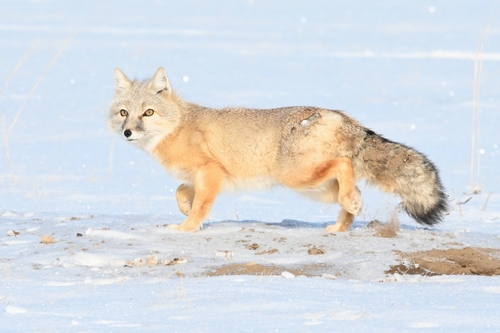
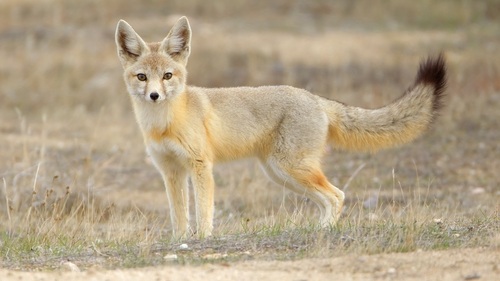
The kit fox (Vulpes macrotis) is a fox species that lives in arid and semi-arid regions of the southwestern United States, as well as northern and central Mexico. It is the smallest of the four Vulpes species found in North America, and is among the smallest vulpines in the world. Due to its large ears, it has been called the North American counterpart of the fennec fox.
The northernmost point of the kit fox's range is the arid interior of Oregon, and its eastern limit is southwestern Colorado. It can be found southward through Nevada, Utah, southeastern California, Arizona, New Mexico, and into western Texas. Kit foxes live in arid and semi-arid regions that include desert scrub, chaparral, halophytic areas, and grasslands. They generally favor areas with sparse ground cover. Their vegetation habitats vary by regional fauna, with common examples including big sagebrush (Artemisia tridentata) and saltbrush (Atriplex polycarpa). They often prioritize loose textured soils for building dens. Kit foxes can also be found occasionally in agricultural areas, especially orchards, and can even live in urban areas. They occur at elevations between 400 and 1,900 meters (1,300 to 6,200 ft) above sea level.
Kit foxes are a socially monogamous species, and mated pairs stay together year-round, though polygamous mating relationships have also been observed. Female kit foxes begin searching for natal dens in September and October. They usually visit and clean debris out of potential usable dens before making their final selection. No distinct nest is built, but new entrances and tunnels may be added to the chosen den. Like most canids, copulation ends with a "tie" where the male's penis remains locked inside the female's vagina. Females are monoestrous.
Males and females usually form mating pairs during October and November, and mating occurs between December and January-February. Gestation is thought to last around 49 to 56 days, and litters are born in February or March. Litter size is usually four or five pups, and the sex ratio is roughly even. Pups do not emerge from the den until they are at least four weeks old. They are weaned after about eight weeks, become independent at five to six months old, and reach sexual maturity at 10 months old. Both parents participate in raising and protecting their young. Pups emerge from the den at around one month of age, and spend several hours each day playing near the den entrance. During this period, the male usually does most of the hunting; later, both parents provide food until pups begin foraging alongside them at three to four months old.
Annual survival and mortality rates for kit foxes vary significantly from year to year. In captivity, kit foxes live 10 to 12 years, while the average lifespan of a wild kit fox is 5.5 years. One California study of 144 kit fox pups found a 74% mortality rate for pups within their first year.