About Vulpes ferrilata Hodgson, 1842
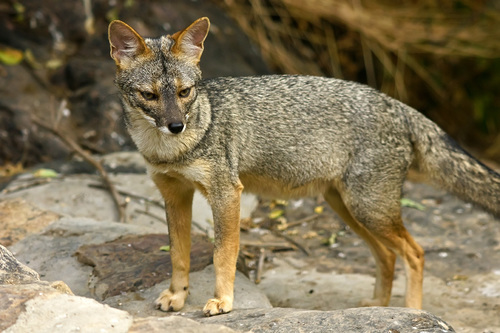
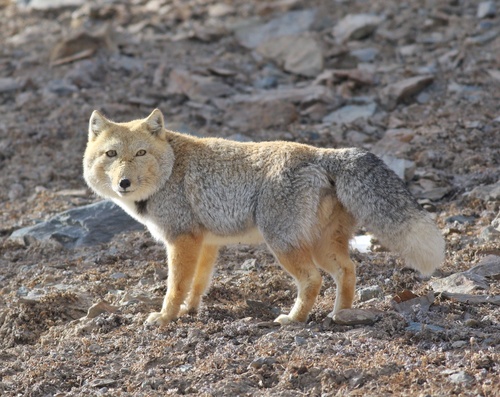
Vulpes ferrilata, commonly known as the Tibetan fox, has a soft, dense rufous coat that covers its crown, neck, back, and lower legs. It has a narrow muzzle; grey fur on its cheeks, flanks, upper legs, and rumps; and a bushy tail with a white tip. Its short ears are tan to greyish tan on the outer back, with white fur on the inner ear and underside. For adult Tibetan foxes, head-and-body length (excluding the tail) ranges from 60 to 70 cm (24 to 28 in), tail length ranges from 29 to 40 cm (11 to 16 in), and adult body weight typically falls between 4 and 5.5 kg (8.8 to 12.1 lb). Among true foxes, the Tibetan fox has the most specialized skull for a carnivorous diet. Compared to hill foxes, the Tibetan fox has a longer condylobasal skull length, longer mandible and longer cheek teeth, a shorter cranial region, narrower zygomatic arches, much narrower jaws, a concave forehead, and much longer canine teeth. The Tibetan fox is limited to the Tibetan Plateau in western China, and the Ladakh plateau and Sikkim in India. It is found north of the Himalayas in the northernmost border regions of Nepal and India, across all of Tibet, and in parts of the Chinese provinces of Qinghai, Gansu, Xinjiang, Yunnan, and Sichuan. It primarily lives in semi-arid to arid grasslands that are far from human settlements and have little heavy vegetation cover. It inhabits upland plains and hills at elevations between 3,500 and 5,200 m (11,500 and 17,100 ft), and has occasionally been spotted at elevations around 2,500 m (8,200 ft). The Tibetan fox's primary prey is plateau pikas; it also hunts rodents, marmots, woolly hares, rabbits, small ground birds, and lizards. It will scavenge carcasses of Tibetan antelopes, musk deer, blue sheep, and livestock. Tibetan foxes are mostly solitary, and hunt during the daytime because their main prey, pikas, are active during the day. Tibetan foxes can form commensal relationships with brown bears when hunting pikas: bears dig pikas out of their burrows, and the foxes catch the pikas when they escape the bears. Mated pairs stay together and may even hunt together. After a gestation period of approximately 50 to 60 days, two to four young are born in a den. The young stay with their parents until they are eight to ten months old. Tibetan fox dig their burrows at the base of boulders, along old beach lines, and on low slopes. Dens may have up to four entrances, and each entrance is between 25 and 35 cm (9.8 and 13.8 in) in diameter.