About Vulpes chama (A.Smith, 1833)
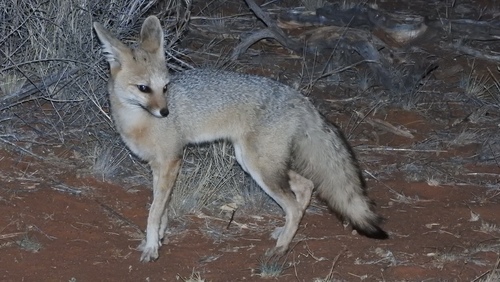
Vulpes chama, also called the Cape fox, is a small canid. Excluding the tail, its body length is usually between 45 and 62 cm (17.5 to 24.5 in), while its tail measures 30 to 40 cm (12 to 15.5 in). It stands 30 to 35 cm (12 to 14 in) tall at the shoulder, and weighs between 2.5 and 4.5 kg (5.5 to 9.9 lb). Its skull is very similar to that of Vulpes bengalensis, though the cranium of V. chama is slightly wider and its maxillary region is slightly shorter. It has relatively large, pointed ears and a small, pointed muzzle. Its fur is silvery-gray, with tawny color on the back of the ears; white hairs appear around the center of the outer ear (pinna). The neck and sides are lighter in color, and the underparts range from pale tawny to pale buff. The head is dull red, the lower jaw is dark brown, and there are white markings on the throat. The legs are more tawny than the rest of the body. The tail is dense and bushy, and can be silvery, pale fawn, or buff with a brown or black tip, or dull yellow. The tail tip is always black, and there is a dark spot over the caudal gland. The fur is soft, made up of a thick, wavy underfur that is around 25 mm (1 in) long. The underfur is covered by a dense layer of guard hair that is less than 40 mm (1.6 in) thick. Molting happens during the wet season, from October to November. V. chama shows little to no sexual dimorphism. It is the only species in the genus Vulpes that lives in Africa south of the equator. It primarily lives in arid and semi-arid areas, but it can also be found in areas with higher rainfall and denser vegetation, such as the fynbos biome of the western Cape Province of South Africa. It is widespread across the central and western regions of southern Africa, ranging as far north as 15 ° N in south-western Angola. It is widespread in Zimbabwe, Botswana, and South Africa, where it occurs across most of the Western and Northern Cape provinces, the Eastern Cape (excluding its southeastern side), the Free State, western and northwestern KwaZulu-Natal, and the North-West province. It also occurs in Lesotho, a high mountainous region. Its breeding season falls in July and August, which is winter in the southern hemisphere. Monogamous pairs may form during this time, but the duration of pair bonds and whether they persist from year to year is not well understood. Paired adults generally only interact during the mating season, though they do perform greeting behaviors including mouth sniffing, nuzzling, and body slamming. Female Cape foxes have a gestation period of 51 to 53 days, and give birth to litters of 1 to 6 cubs (also called kits). Cubs typically weigh between 50 and 100 g (1.8 to 3.5 oz) at birth. Cubs are reared underground in burrows, and stay close to the den until they are about four months old. Multiple females may simultaneously share the same den. Cubs are weaned at around six to eight weeks of age, but do not start foraging until they are four months old. They often play outside the den during daylight hours. Both parents care for the young; the male provides food for the female for at least 1–2 weeks after birth. Cubs typically become independent at between 5 and 11.5 months of age, when they disperse, usually in June or July. Juveniles may disperse 7–22 km (4.3–13.7 mi) from their natal den, while females may stay within their natal range. Some subadult Cape foxes steal food that the parents bring to the cubs at the den. A family group usually consists of the parents and their offspring, but different family groups sometimes mix while feeding. Multiple litters in a single female are possible and have been observed; however, when a female is expecting another litter, she usually chases the cubs from her previous litter out of the den. Cape foxes reach full size within about a year, and both females and males reach sexual maturity at 9 months old. The Cape fox has a life expectancy of about six years, and can live up to 10 years.