About Vulpes bengalensis (Shaw, 1800)
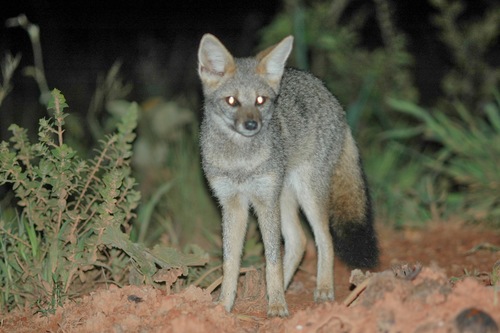
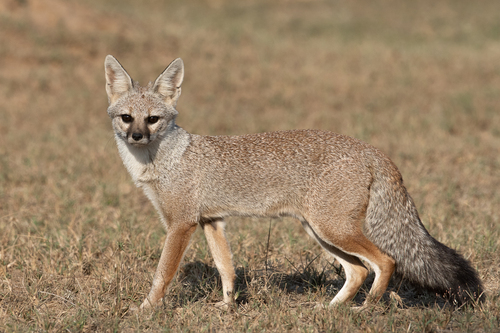
The Bengal fox (scientific name Vulpes bengalensis (Shaw, 1800)) is a relatively small fox species with an elongated muzzle, long pointed ears, and a long bushy tail. Its fur (pelage) ranges in color from buff to silver-gray, creating an overall grizzled appearance; it is mostly grayish on the back (dorsally) and paler on the underside (ventrally). The legs are typically brownish or rufous, and the underparts are light, in a pale sand or ginger shade. There is extensive variation in coat color across populations and seasonally within populations, but the typical coat is reddish grey on the upper body, with paler sides and rufous limbs. The Bengal fox has a bushy, black-tipped tail that makes up around 50–60% of the combined head and body length. The backs of the ears are dark brown with a black margin, and the inner ears are white; the ear color matches the nape, or may be darker. Its nose pad (rhinarium) is hairless, and its lips are black. The muzzle is pointed, and there may be a dark smudged marking along the upper muzzle in front of the eyes. Head and body length measures 46 cm (18 inches), with a tail 25 cm (10 inches) long, and the species weighs between 2.3 and 4.1 kg (5 to 9 pounds). Members of the genus Vulpes have a flat forehead between the postorbital processes, which is not inflated by air cells. The postorbital processes themselves are slightly concave, with a raised front edge. The canine teeth are longer than those of other canid species. The Bengal fox is endemic to the Indian subcontinent. Its range extends from the Himalayan foothills and Terai of Nepal through Southern India, and from southern and eastern Pakistan to eastern India and southeastern Bangladesh. The species' range is bounded by the Himalayas and the Indus River valley. It prefers semiarid, flat to gently rolling land, bush, and short grassland habitats, and avoids dense forests, steep terrain, tall grasslands, and true deserts. Historical records note the species was spotted in the southeastern regions of Cumilla and Chattogram in the 1980s, but no further sightings have been reported from these areas, suggesting the species may be locally extirpated there. It is relatively widespread in low rainfall areas where vegetation is typically scrub, thorn or dry deciduous forests, or short grasslands. On the Indian peninsula, the species is restricted to plains and open scrub forests. While it was once considered a habitat generalist, it shows a strong preference for semiarid, short grassland habitats at multiple spatial scales. Bengal foxes are predominantly active at dawn and dusk (crepuscular) and during the night (nocturnal). Individuals may sometimes be active during cool daytime periods, but they typically spend warm daylight hours resting under vegetation or in underground dens. They use three distinct types of dens: basic, compact dens with two openings for short rest periods, complex dens with multiple openings, and dens built under rocks or in rock crevices. The basic social unit of the Bengal fox is the long-term breeding pair, whose pair bond can last for many years. Larger groups may form when mature pups stay longer in their birth community, and some evidence indicates Bengal foxes can be more social at times. Female Bengal foxes have been reported to share dens during lactation, and four adult foxes have been observed emerging from the same den. Bengal foxes are not particularly wary of humans, can be found near human settlements, and are easy to tame. During the breeding season, male Bengal foxes vocalize intensely at night, as well as at dusk and dawn. Across most of the species' range, mating occurs from December to January. After a gestation period of around 50–53 days, two to four pups are born in a den. Both parents take part in raising and protecting the pups. Groups of mature foxes have been recorded at den sites when dispersal is delayed, though no helper individuals have been observed. Pups may sometimes be nursed by multiple females, but the relationship between these females is not clear. During the day, Bengal foxes tend to rest under shrubs and bushes, except in summer when they rest in dens. Play between pups is typical during the first three months of life, and includes vertical jumps, back arching, foreleg stabs, submissive displays, and play solicitation; the adult male will sometimes play with the young. In northwestern India, young foxes disperse during the monsoon season, when food resources are abundant. Pups are fully weaned about 3–4 months after emerging from the den, and pup mortality is high during the first few months of life.