About Vombatus ursinus (Shaw, 1800)
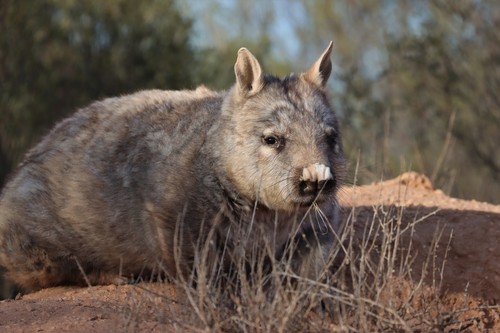
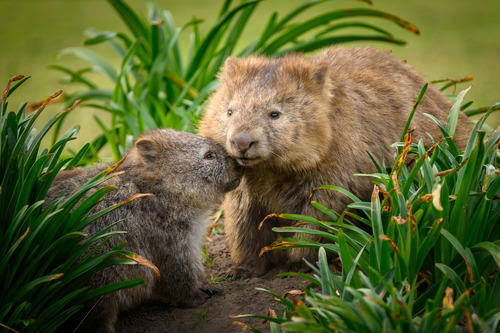
Common wombats (Vombatus ursinus) are sturdy, low-built marsupials with small ears and eyes, and a large bald nose. Their fur is thick and coarse, and ranges in color from light brown to grey and black. There are three subspecies that vary in size: the Flinders Island wombat is the smallest, reaching around 75 cm (30 in) in length; the Tasmanian wombat averages 85 cm (33 in) long and 20 kg (44 lb) in weight; the mainland subspecies is the largest, with an average length of around 1 m (3 ft 3 in) and an average weight of 27 kg (60 lb). Large individual common wombats can grow to 1.2 m (3 ft 11 in) long and weigh up to 35 kg (77 lb). Common wombats have short, strong legs with long claws, and are very efficient diggers. A trait that distinguishes common wombats from all other marsupials is that they have a single pair of upper and lower incisors, which grow continuously throughout their life. Scientists estimate that around 1.3 million common wombats remain in the wild, with more than two thirds of this population restricted to islands including Tasmania, though overall national population numbers are declining. Common wombats are widespread in the cooler, better-watered parts of southern and eastern Australia, including Tasmania and Victoria, and in mountain districts as far north as southern Queensland. In Tasmania, common wombats prefer heathland, coastal scrub, and open forest. Across their range, they can be found at any elevation in the southern portion, but are only found in higher, more mountainous areas in the northern portion. They occupy a variety of habitats including rainforest, eucalyptus forest, woodland, alpine grassland, and coastal areas. In some regions, they have adapted to farmland, and can be seen grazing in open fields alongside cattle and sheep. Human activity has caused the common wombat's distribution and population to shrink by more than half since European settlement. Historically, their range extended from South Australia's Limestone Coast throughout most of Victoria (excluding the desert areas of the northwest), along the Great Dividing Range through New South Wales and into South East Queensland. The most substantial impact on their population came from a $1 bounty declared in Victoria between 1926 and 1966, which labeled common wombats as an agricultural pest due to their burrowing and foraging behavior. This bounty encouraged landowners to eliminate the species, causing local extirpation across much of their former range. The species had no legal protection in Victoria until 2020. Common wombats are still hunted as pests under license in Victoria and the Australian Capital Territory, with up to 2,482 individuals culled nationally each year. Mainland common wombat populations are now largely fragmented, isolated to remote pockets in most states. The species is protected by law in South Australia under the National Parks and Wildlife Act 1972, in Queensland under the Nature Conservation Act 1992, and in New South Wales under the NSW Biodiversity Conservation Act 2016.