About Volvopluteus gloiocephalus (DC.) Vizzini, Contu & Justo
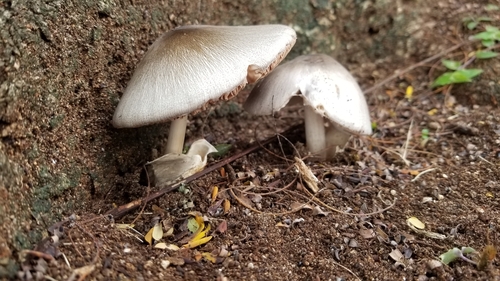
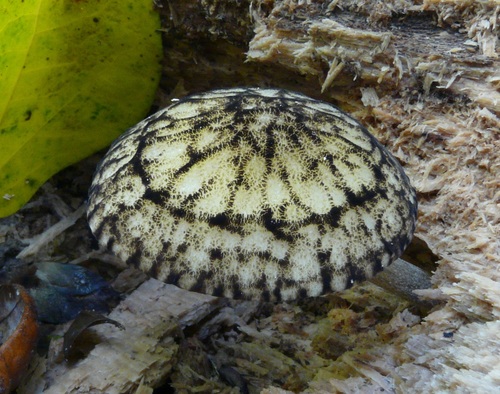
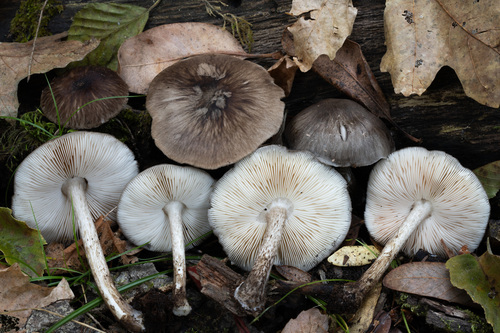
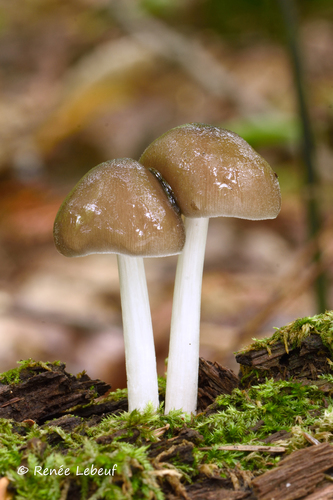
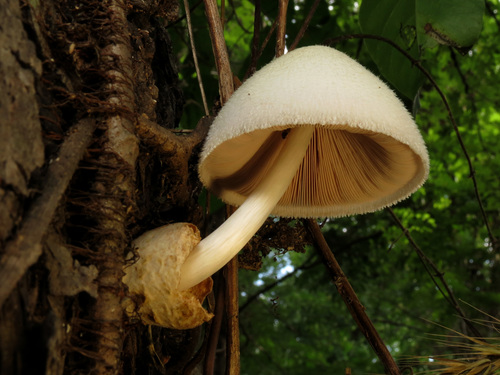
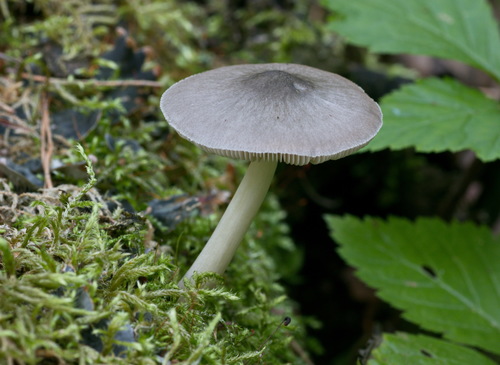
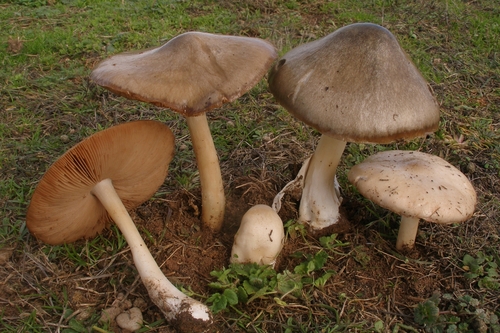
Volvopluteus gloiocephalus (DC.) Vizzini, Contu & Justo has a cap that measures 5 to 15 cm (2 to 6 in) in diameter. When young, the cap is more or less ovate or conical; as it matures, it expands to become convex or flat, and old specimens sometimes develop a slight central depression. The surface of fresh basidiocarps is markedly viscid, and cap color ranges from pure white to grey or greyish brown. The gills are crowded, free from the stipe, ventricose (swollen in the middle), and up to 2 cm (0.8 in) broad. They are white when young and turn pink as they age. The stipe is 5–22.5 cm (2–9 in) long and 0.7–2.5 cm (0.3–1.0 in) wide, cylindrical, and broadens toward its base. The stipe surface is white, and is either smooth or slightly pruinose, meaning it is covered with fine white powdery granules. The volva is 2–3 cm (0.8–1.2 in) high, sacciform (pouch-like), white, and has a smooth surface. The flesh of both the stipe and cap is white, and does not change color when bruised or exposed to air. Smell and taste can be indistinct, raphanoid (radish-like), or similar to raw peeled potatoes. The spore print is pinkish brown. Basidiospores are ellipsoid and measure 12–16 by 8–9.5 μm. Basidia measure 20–35 by 7–15 μm, are usually four-spored, but occasionally two-spored basidia can occur. Pleurocystidia measure 60–90 by 20–50 μm and have variable morphology: they can be club-shaped, fusiform, ovoid, and sometimes have a small apical papilla. Cheilocystidia measure 55–100 by 15–40 μm and have similar morphology to pleurocystidia; they completely cover the gill edge. The cap cuticle (pileipellis) is an ixocutis, meaning it consists of parallel hyphae widely embedded in a gelatinous matrix. The stipe cuticle (stipitipellis) is a cutis, meaning it consists of parallel hyphae not embedded in a gelatinous matrix. Caulocystidia are sometimes present, measure 70–180 by 10–25 μm, and are mostly cylindrical. Clamp connections are absent from the hyphae.
Volvopluteus gloiocephalus is a saprotrophic mushroom that grows on the ground in gardens and grassy fields, both inside and outside forest areas. It also grows on accumulations of vegetable matter such as compost or woodchip piles, and has been reported fruiting in greenhouses. In China, it grows in bamboo thickets. It usually fruits in groups of several basidiocarps, but can also be found growing solitary. It is not unusual for a season of spectacular heavy fruiting to be followed by several years with no appearance of the mushroom. This species has been reported from all continents except Antarctica, usually under older names such as Volvariella gloiocephala or V. speciosa. Molecular data has so far confirmed its occurrence in Europe and North America, but records from other continents remain unconfirmed.
Volvopluteus gloiocephalus is edible, although it is considered watery and poor in quality. It was once sold in markets in Perth, Australia. When mature fruit bodies are collected in sufficient quantity, they can be used to prepare soup, or added to dishes that use wild mushrooms such as stews and casseroles. The mushrooms are best used fresh, as they do not preserve well. Young specimens of V. gloiocephalus have white gills, so it is possible to mistake them for an Amanita and vice versa. In the United States, there have been several cases of Asian immigrants collecting and eating death caps (Amanita phalloides), under the mistaken assumption that they were this species (previously classified in Volvariella). A Greek study determined the nutritional composition of V. gloiocephalus fruit bodies: 1.49 g protein per 100 g fresh weight (fw), and 18.36 g protein per 100 g dry weight (dw); 0.54 g fat per 100 g fw, and 6.65 g fat per 100 g dw; 5.33 g carbohydrates per 100 g fw, and 65.64 g carbohydrates per 100 g dw.