About Volvariella surrecta (Knapp) Singer
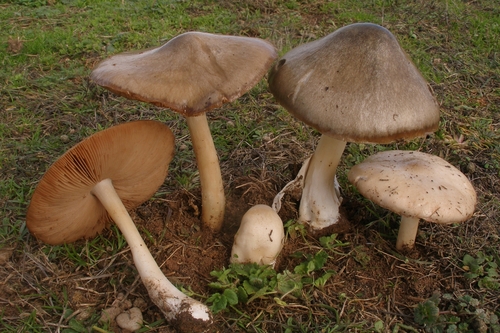
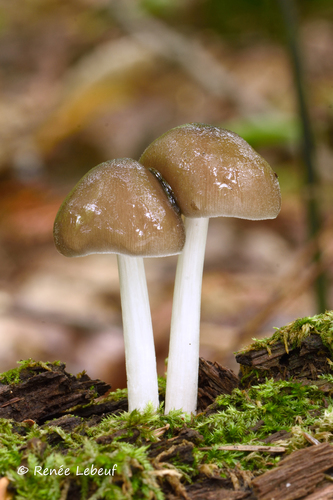
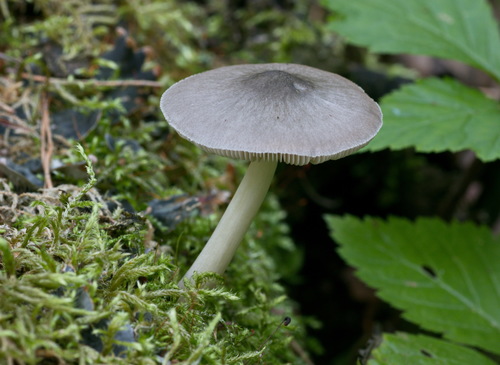
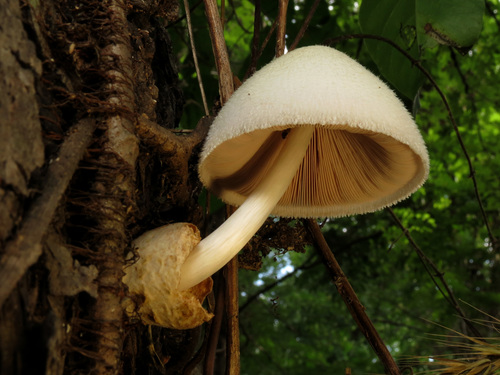
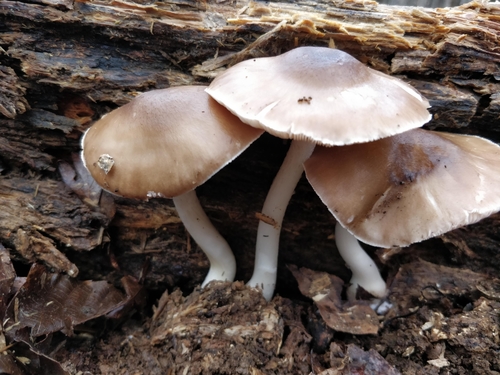
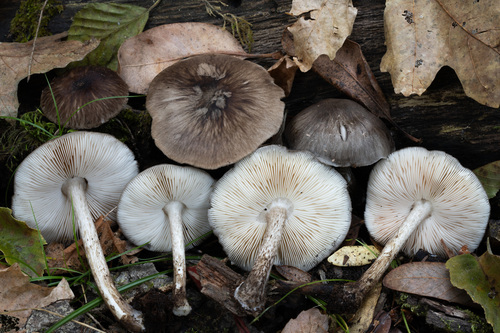
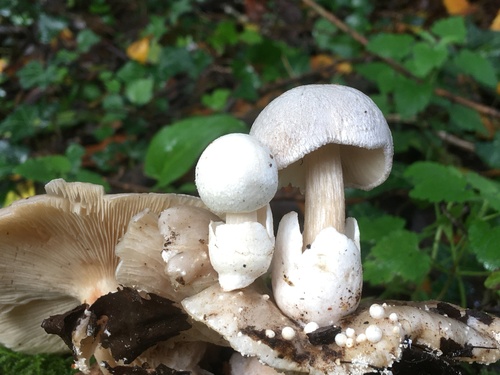
The fruit bodies of Volvariella surrecta have caps that start out egg-shaped. They later become bell-shaped or convex before flattening out, reaching a diameter of 2.5–8 cm (1.0–3.1 in). The cap sometimes has a shallow umbo, but this feature is not consistently present. The cap surface is dry, covered with long silky hairs, and colored white to light gray, with a yellowish or brownish center. The gills are not attached to the stipe and are packed closely together. They start white and turn pink as they mature. Many short gills called lamellulae, which do not extend fully from the cap margin to the stipe, are interspersed between the full-length gills. The stipe is 4–9 cm (1.6–3.5 in) long, 4–12 mm (0.16–0.47 in) thick, roughly equal in width along its length, or somewhat thicker at the base. It is colored white to light gray; the stipe surface is appressed-fibrillose, with a pruinose coating near its apex. The white volva is 1.3–2.5 cm (0.5–1.0 in) high, 0.6–1.3 cm (0.2–0.5 in) broad, and has a lobed margin. Volvariella surrecta is not edible. Its spore print is brownish-pink. Spores are egg-shaped to oval, measuring 5.4–7.6 by 3.4–4.9 μm. The spore-bearing cells called basidia are club-shaped, four-spored, and measure 20–31 by 5–10 μm. Pleurocystidia (cystidia on the gill face) are fusoid-ventricose (distinctly enlarged in the middle and tapered toward both ends), sometimes with an elongated neck. Cheilocystidia (cystidia on the gill edge) are also fusoid-ventricose, with a neck that is sometimes short and bulbous; they measure 25–50 by 6–20 μm. The hyphae do not have clamp connections. Volvariella surrecta grows parasitically on the fruit bodies of Clitocybe species, most commonly Clitocybe nebularis, though it has also been recorded growing on Tricholoma species and Melanoleuca brevipes. The mushrooms grow in clusters, and fruit during summer and autumn. The host mushroom is sometimes malformed and develops an irregular shape. In an early publication, mycologist Charles Bagge Plowright noted that illustrations published by Berkeley and by Knapp (under the name Agaricus surrectus) are misleading, as both depict the host Clitocybe nebularis as very robust. In Plowright's specimen, the host A. nebularis was sodden and collapsed, practically unrecognizable unless one already knew what species to expect. Volvariella surrecta is a rare species, even though its main host is quite common; the environmental conditions required for this parasite to produce fruit bodies are not well understood. Some authors have suggested that it may grow equally well as a parasite or a saprobe. V. surrecta has been found growing on its host in a range of habitat types, including birch woodlands, pine plantations, scrub, thickets of small trees or shrubs beside roads, and under brambles. It has been found growing in sand, clay, gravel, and peat soils, so no definite preference for a specific soil type has been identified. In 1867, Worthington George Smith reported that he successfully cultivated the species by partially burying fruit bodies under water-soaked rotting fir leaves, placed inside a bell-glass kept in a warm room. According to his account, white mycelium grew over the leaves and eventually formed small white pins (immature, undifferentiated fruit bodies), which developed into fully formed mushrooms about two weeks after starting growth. The known geographical distribution of this fungus includes North America north of Mexico, northern Africa, Europe, New Zealand, and Asia (the Amur region of Russia, India, and Korea).