About Volvariella bombycina (Schaeff.) Singer
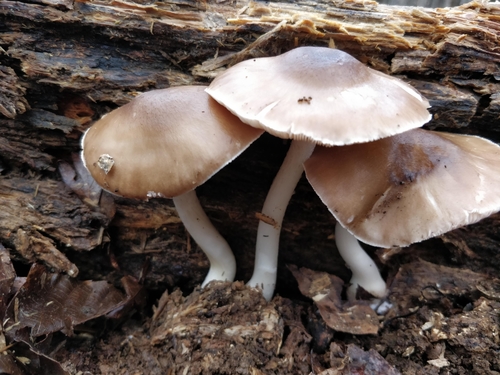
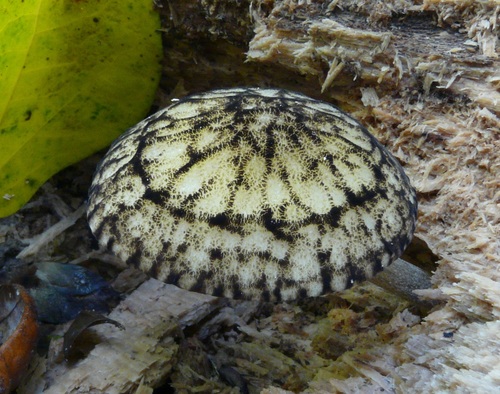
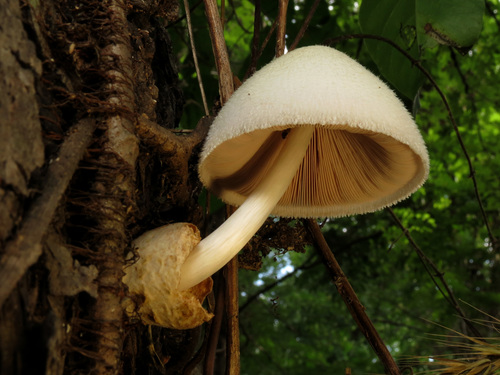
Fruit bodies of Volvariella bombycina are initially fully enclosed by a universal veil. Caps start oval, then mature to bell-shaped or convex, and sometimes become nearly flat in older individuals; they range 5–20 centimetres (2–8 inches) wide. The cap is white to yellowish, paler at the margin, dry, and covered in silky threads. The cap flesh is thin, soft, white, and has an odor similar to raw potatoes. Gills are crowded, not attached to the stem, start white, and turn pinkish as spores mature. The stem measures 6–20 cm (2+1⁄2–8 in) long and 1–3 cm (1⁄2–1+1⁄4 in) thick, typically tapering upward or thickening toward the base. It is white, smooth, and often slightly curved. The universal veil is membranous, frequently cracked into irregular blocks (areolate) or scaly, and forms a long, saclike volva that surrounds the base of the stem. This volva is white to yellowish or dingy brown, and often split into lobes. Three varieties of V. bombycina have been described, each with distinct traits. V. bombycina var. flaviceps differs from the typical variety by its smaller, bright yellow caps that reach up to 3.5 cm (1+1⁄2 in) in diameter, plus its dirty-white, scaly volva; Murrill also observed that this variety develops a peculiar sickening odor when dried. V. bombycina var. microspora has smaller spores (measuring 6–7.5 by 4–5 μm), a yellow cap, and a blotched brown volva. V. bombycina var. palmicola also has a yellow cap and small spores (5.9–7.5 by 4.3–5.4 μm), but can be told apart from the other varieties by its distantly spaced gills. Sporulation produces a spore print that ranges in color from pinkish to salmon. The spores are elliptical, smooth, and measure 6.5–10 by 4.5–6.5 μm. Spore-bearing cells called basidia are club-shaped, produce four spores each, and measure 19–43 by 6–11 μm. Pleurocystidia (cystidia on the gill face) are usually spindle-shaped, but have highly variable morphology; they are abundant in the hymenium, and measure 26–122 by 8–57 μm. Cheilocystidia (cystidia on the gill edge) have similar morphology and abundance to pleurocystidia; some cheilocystidia have knobs at the end of slender projections up to 20 μm long, and range 26–144 μm long by 8–46 μm wide. Clamp connections are not present in the hyphae of V. bombycina, and its fruit bodies can be easily grown in laboratory culture. Volvariella bombycina is a saprobic species. Its fruit bodies grow singly or in small groups on trunks and decayed stumps of dead hardwoods; commonly affected hardwood species include sugar maple, red maple, silver maple, magnolia, mango, beech, oak, and elm. Fruit bodies often grow in clefts and knotholes of dead or living tree trunks, and have been recorded fruiting in the same location for multiple years. Though it prefers hardwoods, it has rarely been found growing on coniferous wood. This is an uncommon species with a broad distribution, and has been reported from Europe, Asia (Iran, China, India, Korea, and Pakistan), North America, South America, the Caribbean (Cuba), and Australia. It was granted protected status in Hungary in 2005, meaning picking it is a criminal offense. Variety microspora is only known from Venezuela, while V. bombycina var. palmicola grows in the Democratic Republic of the Congo. The fruit bodies of V. bombycina are edible, and generally rated as good quality. They have been described as excellent, tasty with a modest and pleasant flavor, and worth eating if found in large enough quantities.