About Volucella zonaria (Poda, 1761)
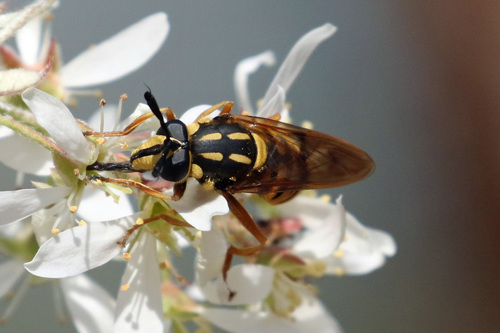
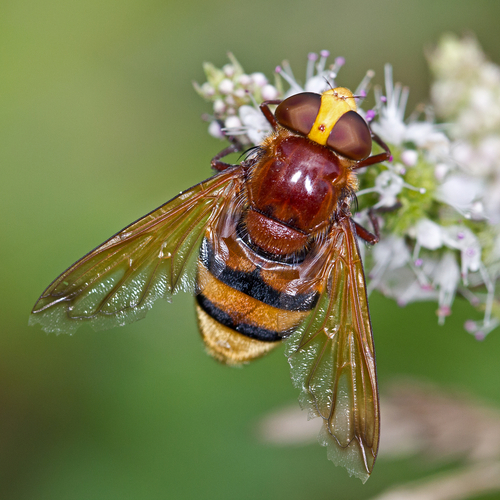
Volucella zonaria can reach a body length of 25 millimetres (0.98 in), with a wingspan of about 40 mm. These are very large, broad-bodied hoverflies. They have a shiny reddish-brown thorax marked with dark brown, and a reddish-brown scutellum. The head has a waxy yellow face, with yellow forehead and yellow antennae. The large, oval compound eyes are reddish, covered in dense short hairs. In males, the two compound eyes are positioned very close to one another, making the forehead very narrow. The abdomen is reddish yellow, marked with two wide black bands. Broad black bars run along the underside of the body. The first abdominal segment is black, and the second abdominal tergite is chestnut brown. The wings have an amber tint. The legs are mainly red-brown, but are black at the base. This species mimics the European hornet, Vespa crabro, through its size, general appearance, and buzzing flight. This species is found across most of Europe, as well as in Tunisia, Iran, Russia (extending to the Russian Far East), and Mongolia. In Great Britain, only two specimens were known prior to 1940, so the species was considered rare. Since 1940, it has become increasingly widespread across many parts of southern and south-eastern England, where it is often found in parks and gardens, with adults most commonly seen visiting flowers. Scattered records only exist for the species in other parts of England. These hoverflies typically live in meadows located close to forests.