About Volucella pellucens (Linnaeus, 1758)
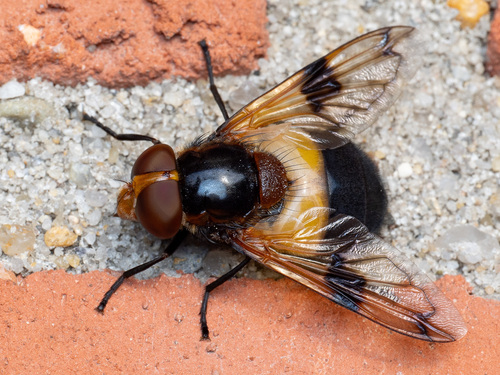
Volucella pellucens (Linnaeus, 1758) is a hoverfly that reaches a total body length of 13–17 mm, with an individual wing length of 10–15.5 mm. It has a broad, mostly black body, with a wide yellow band across the front section of its abdomen. This body pattern and shape give it a strong resemblance to a bee or a wasp. Like most flies, its two wings are transparent overall. The leading edge of each wing is amber-colored, and each wing also has a distinct brown patch. This species shares bee/wasp mimicry in body shape and coloration with many other hoverfly species. This mimicry is thought to protect it from predation: birds and other insect-eating animals avoid hunting this hoverfly, because they avoid eating true stinging wasps. One clear difference between hoverflies like this and actual bees or wasps is that hoverflies have only two wings, while all bee and wasp species in the order Hymenoptera have four wings. Volucella pellucens is distributed across most of Europe, and ranges across the entire Palearctic region all the way to Japan. Adult individuals of this species are most commonly found in woodlands and wooded hedgerows, but they will also enter and visit gardens.