About Volucella bombylans (Linnaeus, 1758)
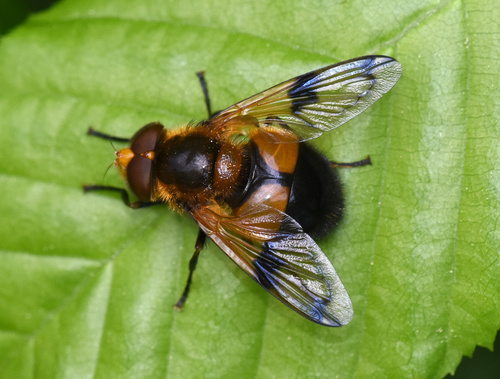
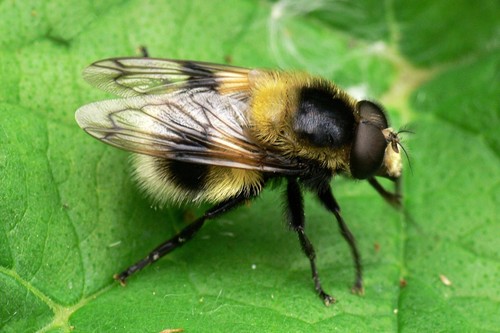
Volucella bombylans is larger than most hoverflies, with a body length of 11 to 17 millimeters and a wingspan of 8–14 millimeters. It has a furry body in black, yellow and/or white, giving it a general bumblebee-like appearance. However, several features including its head shape, plumed antennae, large eyes, and characteristic wing venation easily distinguish it as a true fly, similar to a blowfly. The mesonotum has black or yellow hairs along its sides, while the scutellum is brownish or yellowish. The wings are milky white, with dark cross-bands on the anterior half and a diffuse dark spot at the wing tip. The abdomen is yellow at the base, black in the middle, and covered in long, dense hairs at the end. The legs are relatively short and black. This species has multiple forms that each engage in Batesian mimicry of a different bumblebee species. The two main varieties are Volucella bombylans var. bombylans, which has an orange-red tail and mimics the Red-tailed Bumblebee (Bombus lapidarius), and Volucella bombylans var. plumata, which has a white tail and mimics both the White-tailed Bumble Bee (Bombus lucorum) and the Buff-tailed Bumblebee (Bombus terrestris). Volucella bombylans var. plumata is also rather similar to two other syrphid species: Arctophila bombiformis and Merodon equestris. This species is distributed across most of Europe, the East Palearctic realm, the Near East, and the Nearctic realm. These hoverflies inhabit forest edges and clearings, woodland margins, hedgerows, wet meadows, spruce forest edges, urban wasteland, and gardens, and they can usually be found sunning on leaves.