About Viviparus viviparus (Linnaeus, 1758)
Scientific name: Viviparus viviparus (Linnaeus, 1758)
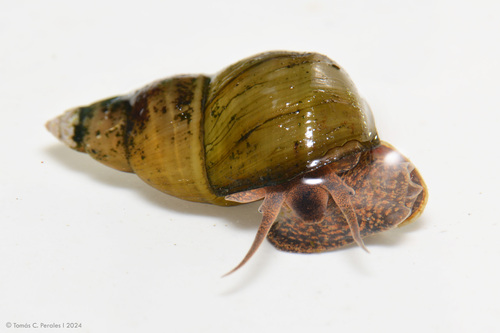
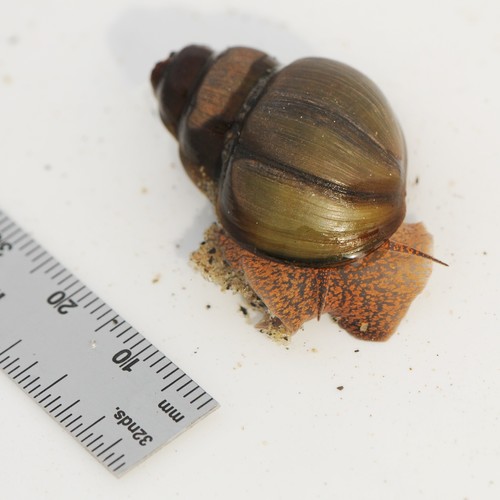
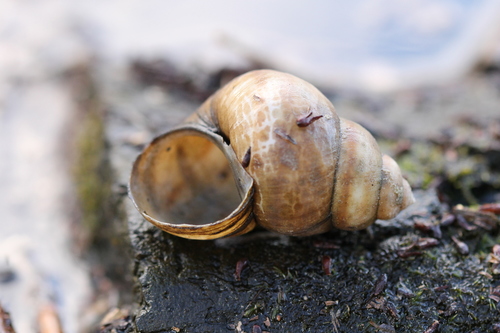
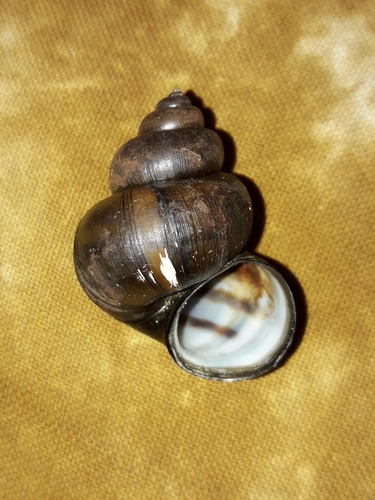
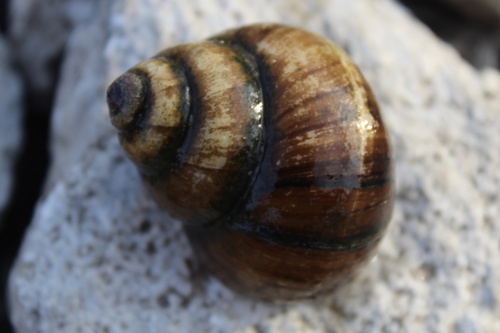
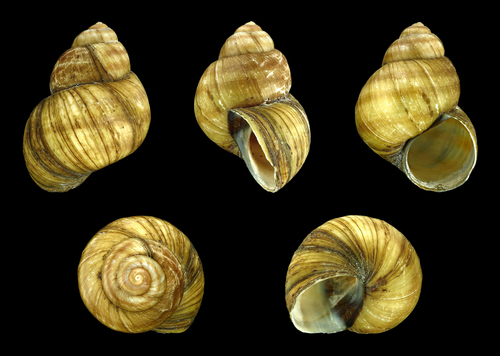
Description: The shell of Viviparus viviparus measures 25–35 mm in height and 20–26 mm in width. Males are 2 mm smaller than females of the same age. The shell is dark greenish brown or greyish yellow, with three reddish brown spiral bands. It is striated but lacks any hammer pattern, and has a blunt apex (the apex is more pointed in other Viviparus species). There are 5.5-6 weakly convex whorls, and the last whorl is relatively large compared to that of other Viviparus species. The umbilicus is narrow.
The snail can lock itself inside its shell behind a round, concentrically striated operculum (the lid). This structure protects the animal from dehydration for several months if needed; when closed, the operculum sits flush with the shell opening. The operculum attaches to the dorsal surface of the rear of the gastropod’s foot. The foot itself is wide and T-shaped, and its body colour ranges from spotted grey to greenish to orange. The mouth has a radula, and a respiratory siphon opens on the right side of the head, supplying gills located in front of the heart. This siphon also allows the animal to filter water. There are two short tentacles, with eyes positioned on the external side of each tentacle.
Distribution and habitat: This is a European species found in Romania, Slovenia, Croatia, the Czech Republic (only in Bohemia), Germany, the Netherlands, Poland, Great Britain, Ireland, and other European countries. Viviparus viviparus is largely restricted to major slow-moving lowland rivers and lakes, and prefers calcareous (base-rich) waters. It is often found in deep water. It sometimes forms dense clusters of thousands of individuals on submerged branches and various submerged man-made objects. More rarely, it occurs scattered and much more discreetly in bottom mud. It also lives in canals, artificial ponds, dammed water, and reservoirs, but is usually not found in small isolated standing waters. It requires water with high oxygen content.
Reproduction: As its Latin name suggests, Viviparus viviparus is a viviparous (ovoviviparous) snail, a rare trait among snails. Females give birth to live young, after eggs develop and hatch internally. Naturalist Jan Swammerdam was the first to identify the viviparous character of this species; he named it Cochlea mirabilis and Cochlea vivipara, but does not appear to have understood that this species has separate male and female individuals (most other snails are hermaphroditic). In 1863, Émile Baudelot clearly stated that paludines (river snails) have two distinct sexes. The male reproductive system extends from the anterior end of the right tentacle to the top of the spire, and can be divided into four distinct sections from top to bottom: the testis, vas deferens, seminal reservoir, and the penis. Males can be distinguished by a shorter right tentacle with a rounded tip, which also acts as a penis during fertilization. Females are usually slightly larger than males of the same age, and have two identical tentacles.
Sexual maturity is reached after two years, when the snail is about 2 cm long. Each female carries up to 30 eggs at all stages of development, which range from 3 to 7 mm in diameter and are retained until the embryo is fully developed. When the young are expelled, they are about 7 mm long, and their shells already have the characteristic stripes of this river snail. After producing all of its young, the female dies. In 1879, Mathias Duval conducted studies on spermatogenesis in Viviparus viviparus.