About Viverricula indica (É.Geoffroy Saint-Hilaire, 1803)
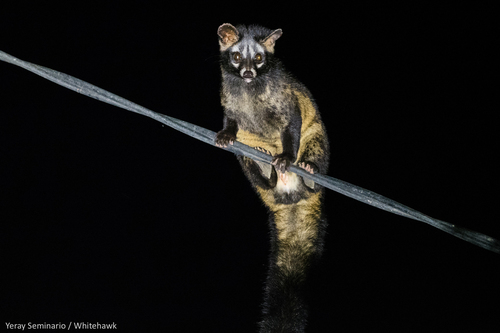
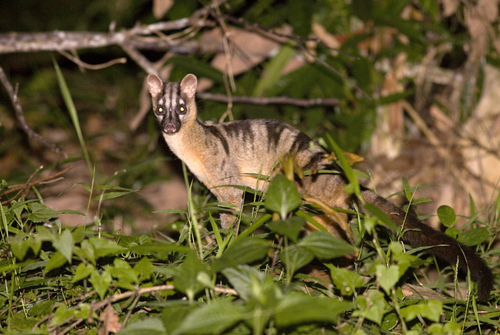
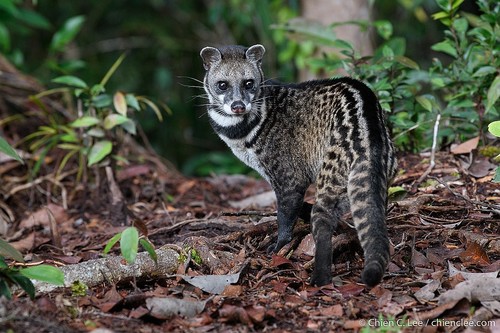
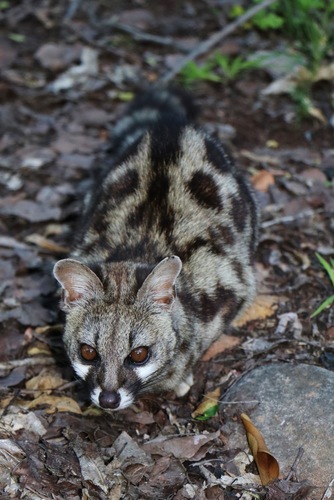
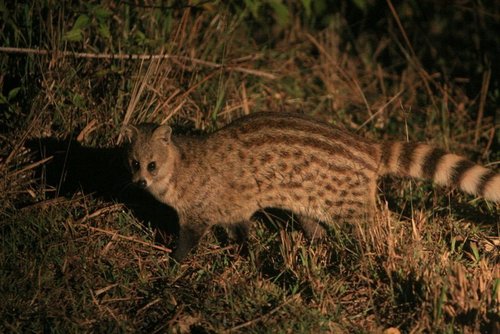
Viverricula indica, commonly called the small Indian civet, has distinct physical characteristics. Its fur is rather coarse, and ranges in color from brownish grey to pale yellowish brown. Most individuals have several longitudinal black or brown bands across the back, plus longitudinal rows of spots on the sides. Typically, there are five or six clear bands on the back, and four or five rows of spots on each side. Some individuals have indistinct lines and spots, and may lack dorsal bands entirely. Most have two dark stripes that run from behind the ear to the shoulders; a third stripe often appears in front, crossing the throat. The civet's underfur is brown or grey, most often grey on the upper body and brown on the lower body. Grey hairs on the upper body are frequently tipped with black. The head is grey or brownish grey, and the chin is often brown. The ears are short and rounded, with a dark dusky mark behind each ear and one in front of each eye. The civet's feet are brown or black. Its tapering tail has alternating black and whitish rings, with seven to nine rings of each color. Head-to-body length ranges from 53 to 58 centimeters (21 to 23 inches), and the tail measures 38 to 43 centimeters (15 to 17 inches) long. The small Indian civet is distributed across most of India, Sri Lanka, Myanmar, Thailand, Laos, Cambodia, Vietnam, south and central China, and Taiwan. It was historically recorded in Bhutan, Bangladesh, Peninsular Malaysia, Java, and Bali, but there are no recent confirmed records from these areas. Its current status in Singapore is unknown. It is widely distributed in Chitwan National Park, occurring in both grasslands and Shorea robusta (sal) forest. In 2008, the species was recorded for the first time in Dachigam National Park, at 1,770 meters (5,810 feet) elevation in a riverine forest. In northeast India, it has been recorded at elevations up to 2,500 meters (8,200 feet). During 2002 surveys in Kalakkad Mundanthurai Tiger Reserve, the small Indian civet was recorded most often in grassland and riverine areas, and was sighted near a tea plantation. During 2008 surveys in India's Western Ghats, small Indian civets were observed in Anamalai and Kalakkad Mundanthurai Tiger Reserves, as well as Parambikulam and Chinnar Wildlife Sanctuaries. In Mudumalai Tiger Reserve, it has been recorded in deciduous forest, semi-evergreen forest, and thorn forest; during the dry season, it is also found at water holes near villages. In Myanmar, it has been recorded in mixed deciduous and bamboo forests in Hlawga National Park. During surveys conducted between 2001 and 2003 in Hukawng Valley, it was recorded in grasslands and forest edges at elevations of 240 to 580 meters (790 to 1,900 feet). In 1999, it was recorded in closed tall forest in Alaungdaw Kathapa National Park. In Thailand, small Indian civets have been recorded in Kaeng Krachan and Khao Yai National Parks; in the evergreen gallery forest of Thung Yai Naresuan Wildlife Sanctuary; in secondary and dipterocarp forest of Huai Kha Khaeng Wildlife Sanctuary; and in deciduous forest at 700 to 900 meters (2,300 to 3,000 feet) elevation in Phu Khieo Wildlife Sanctuary. In Laos, the species has been recorded across a wide variety of habitats, including semi-evergreen forest, deciduous forest, mixed deciduous forest, bamboo forest, scrubby areas, grasslands, and riverine habitat. During surveys conducted between 2000 and 2009 in Cambodia's Cardamom Mountains, small Indian civets were recorded in deciduous dipterocarp forests, often close to water bodies and in marshes. In eastern Cambodia, most records come from semi-evergreen forest in Phnom Prich Wildlife Sanctuary and Mondulkiri Protected Forest, but the species has also been found in deciduous dipterocarp forests in Siem Pang Protected Forest, Snoul Wildlife Sanctuary, Virachey National Park, and Chhep Wildlife Sanctuary. During interview and camera-trapping surveys carried out between 1997 and 2005 in China's Guangxi, Guangdong, and Hainan provinces, the species was recorded in subtropical forest patches. Small Indian civets are nocturnal, primarily terrestrial, and insectivorous. They live in ground holes, spaces under rocks, or thick bush. Pairs occasionally form for mating and hunting. In areas undisturbed by human activity, they have been reported to sometimes hunt during the day. Though primarily terrestrial, they are also good climbers. Individuals sleep in burrows or hollow logs. They can dig their own burrows, but will also use abandoned burrows dug by other species. In suburban habitats, they use gutters and other hollow, dark spaces as makeshift burrows. Females usually give birth to four or five young per litter. Captive small Indian civets observed in Kerala mated between March and May, and again between October and December. The average gestation period lasts 65 to 69 days. Newborn kittens weigh between 90 and 110 grams (3.2 and 3.9 ounces) at birth, and open their eyes five days after birth. They reach 1,000 grams (35 ounces) by ten weeks of age. The typical lifespan of a small Indian civet in captivity is eight to nine years.