About Vittaria appalachiana Farrar & Mickel
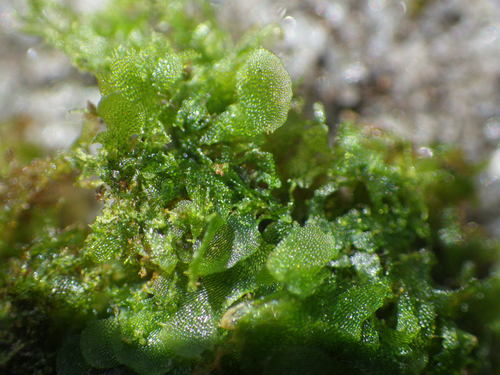
Vittaria appalachiana, a vittarioid fern, almost never develops a sporophyte, the generation that is normally dominant in the fern life cycle. Tiny sporophytes of this species have only been found at a single site in Ohio, and have been produced in culture on two occasions. The few known V. appalachiana sporophytes have rhizomes covered in clathrate, lattice-patterned scales, and undivided, linear fronds less than 5 millimeters (0.2 in) long. These features are typical of vittarioid ferns, other than their very small size. Most V. appalachiana populations are made up entirely of gametophytes, which grow as thin green thalli that range from sparsely to extensively branched. The thallus produces filament-like structures called gemmae that project from its margin near the tips of its branches. Gemmae can break away from the parent thallus and grow into a new independent gametophyte. Individual gemmae range in length from 2 to 12 body cells. Rhizoid primordia only form on the two end cells of each gemma, and are sometimes missing from one or both ends. Overall, gemma production is less uniform in V. appalachiana gametophytes than it is in gametophytes of other Vittaria species. Vittaria appalachiana grows in dense colonies within dark, moist crevices in non-calcareous rock. Its favored habitats are generally dark, sheltered locations protected from extreme temperature and humidity fluctuations, including rock shelters and smaller cavities. It occasionally grows as an epiphyte on the bases of trees that are sheltered within narrow gorges. Confirmed populations of this species occur at altitudes between 150 and 1,800 meters (490 to 5,900 ft).