About Vitis rupestris Scheele
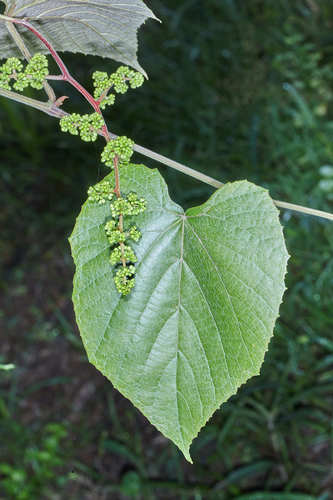
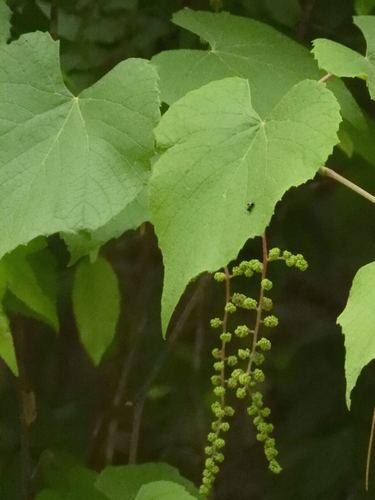
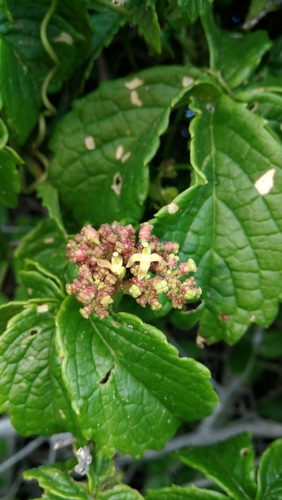
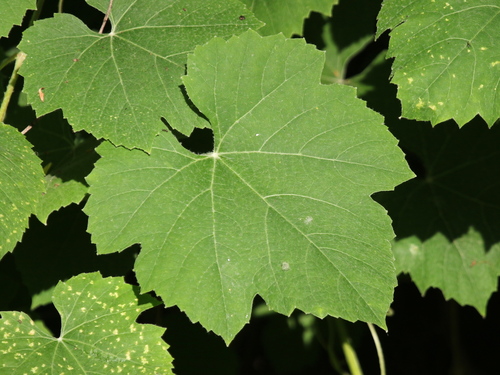
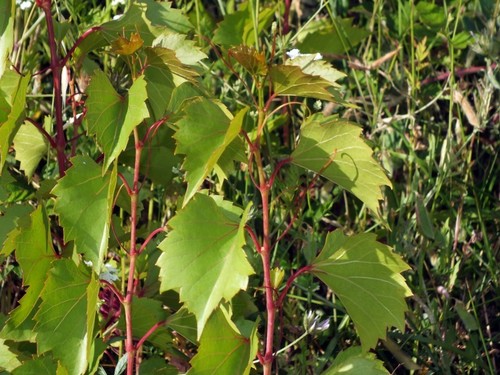
Vitis rupestris Scheele has a tapering, erect, heavily branched growth habit, and rarely climbs more than 4 to 8 feet. Its roots are slender, wiry, and grow deep underground, spreading to reach the water table and allowing the species to resist drought. Young wood is smooth and red; mature wood becomes cylindrical, finely striated, and covered in dark bark that grows darker with age. Aged wood is persistent, dense, but not hard. Buds are small, globose, or slightly conical. Tendrils are small, crimson-colored, and connected by short internodes. Leaves are lanceolate, with large stipules that have crimson veins. Petioles are deeply and broadly grooved along their full length. Leaf blades are distinctly striated and nearly always smooth, usually measuring 3 to 4 inches wide, and sometimes reaching 5 inches wide. Fruit clusters are very small, and sometimes have a shoulder branch. The rachis is smooth and light green. Flowers are fertile, with recurved stamens that bend laterally, and produce abundant pollen. Fruits are 1/4 to 1/2 inch in diameter, round or slightly flattened near the stem, and often appear doubled as if two berries have coalesced. Berries are black with very little bloom, and have a very thin, tender skin. The pulp is tender and melting, deeply colored crimson or violet, and part of the pulp clings closely to the skin. Each berry contains 3 to 4 small seeds, and full fruit clusters grow to around 8 inches long. Germination is quick, and fruit ripens early. If the previous year's wood is lost to winter damage, this species can produce fruit on new young shoots that grow from 2 to 4 year old wood. It propagates easily from cuttings, and its pollen is very prepotent for fertilizing and hybridizing with other Vitis species. The natural distribution of Vitis rupestris is concentrated in the Ozark Hills of Missouri and Arkansas. It occurs less commonly in scattered populations extending east as far as Pennsylvania and southwest into Oklahoma and Texas. A few reports place the species in California's San Francisco Bay area, but these are almost certainly escapes from cultivation. Vitis rupestris is a self-supporting bushy plant that cannot grow in shade, and is only found on rocky riverbanks and streambanks. Much of its native habitat has been destroyed by river damming and the clearing of islands for navigation. Vitis rupestris is listed as threatened or endangered by Indiana, Kentucky, Pennsylvania, and Tennessee. Known wild populations of Vitis rupestris are declining rapidly, which may put the future of this grape species at risk. Within parts of its native range, it naturally hybridizes with Riverbank grape and other Vitis species.