About Vitis amurensis Rupr.
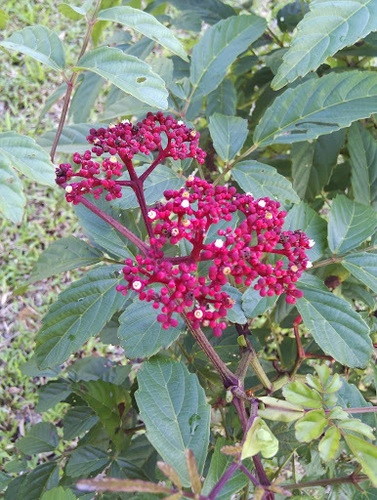
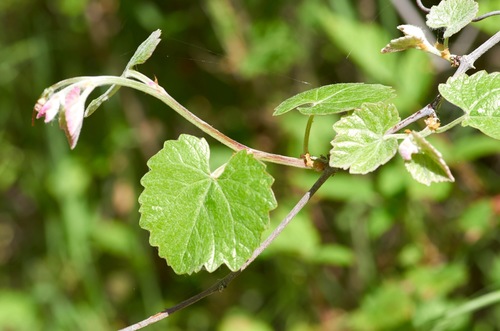
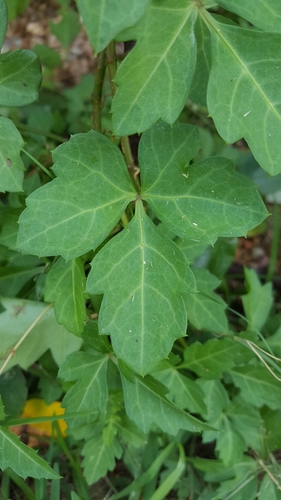
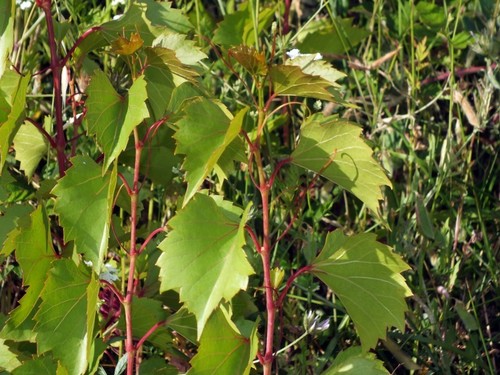
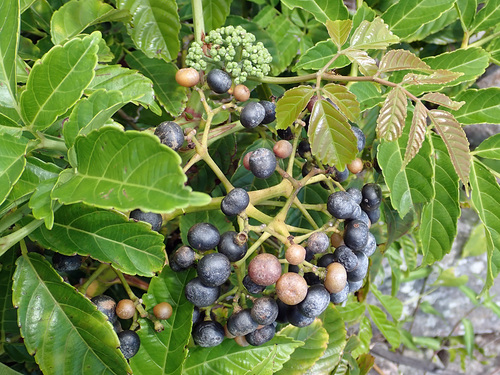
Vitis amurensis Rupr., commonly known as the Amur grape, is a climbing vine. Its stem reaches 5–10 cm in diameter, and the vine typically spreads 15–18 m long, rarely reaching 20–25 m. Wrap-capable tendrils entwine the branches of neighboring plants or any other available support. Old shoots have dark, scaly bark marked with vertical stripes, while young shoots are green, often with a reddish hue, turning reddish-brown in autumn. Leaves vary widely in shape: they may be solid, three-lobed, or five-lobed, and can be ovate or rounded with an arched base. They measure 9 to 25 cm long, with sharp edges lined by rounded-triangular serrate teeth. The upper leaf surface is glabrous, while the lower surface is densely covered with short bristles. In autumn, leaves turn bright shades of red, yellow, orange, and brown. Its small flowers are a nectar source for bees, and appear in the second week of May within the species' natural habitat. The Amur grape is usually dioecious, though hermaphrodite vines occur rarely. Fruits are spherical berries, black or purple, and sometimes dark blue. Their flavor ranges from very acidic to sweet, they typically reach 12 mm in diameter, and they have thick skin. Sugar content in the fruit reaches 22-23%, fruit ripen in late September in their natural habitat, the flesh is juicy, and the berries are usually sour. Fruit clusters can be large relative to the number of berries they contain. In exceptional cases, bunches can grow up to 25 cm long and weigh 250 grams; typical bunches weigh 20-70 g. Vitis amurensis is a relic of pre-glacial subtropical vegetation of the Far East, reaching the continental latitude of Lake Kizi, near the fifty-first parallel. Along the coast of the Sea of Japan, it extends north to the mouth of the Muli river, and west into the Amur region to the Zeya river. It grows in the forests of Manchuria, Amur Oblast, Primorsky Krai, Northeast China (including Anhui, Hebei, Heilongjiang, Jilin, Liaoning, Shandong, Shanxi, and Zhejiang provinces), and Korea. Three varieties are recognized: V. amurensis var. amurensis, V. amurensis var. dissecta, and V. amurensis var. yanshanensis. It is most commonly found in river and stream valleys, clearings, forest edges, forests, and the lower and middle slopes of mountains, where it climbs trees and spreads across the ground. It is the northernmost and most cold-stable species of grape that grows in the Far Eastern taiga; most grape species grow in much warmer climates. Only the Amur grape can tolerate winter temperatures as low as −45 °C, and can tolerate soil temperatures in the root zone down to −16 °C. Human activity has negatively impacted the abundance and conservation status of wild Amur grapes, leading to a noticeable reduction in its natural range. Amur grapes are widely used as an ornamental plant for vertical gardening. They are regularly cultivated as far north as St. Petersburg in European Russia. They are also widely crossed with other grape species, usually Vitis vinifera, to produce cold-hardy, early-ripening wine and dessert grape varieties suited for cold climates. They tolerate urban conditions including smoke, dust, and gases. Amur grapes require approximately 700 mm of rain per year, so they do not grow well in the dry climates typical of many wine regions unless they are irrigated. They grow well in wetter areas usually considered too cool and wet for commercial grape growing, such as Northwest Europe, Northern Russia, and the Pacific Northwest of North America. They are relatively disease-resistant, ripen early, are adapted to a short growing season, and have some partial resistance to phylloxera. They also have mild resistance to a few forms of mildew. Ripe Amur grapes can be eaten raw, and are sweet when fully ripe; they are acidic and bitter when unripe. They are often processed into wine, juice, jellies, and jams, and their leaves can be used in salads. The ripening capacity and growth rate of Amur grape vines is very high; annual growth reaches about 2.5 meters. Amur grape seedlings typically begin blooming around their fifth year. The plant prefers loose acidic soil and cannot tolerate excess lime. It responds positively to the addition of highly acidic peat, and produces the most fruit when grown in full sun. Many hybrid grape varieties created by crossing Vitis amurensis with other species are currently cultivated in northern vineyards, including 'Arctic', 'Buytur', 'Zarya severa', 'Currants Michurin', 'Metal', 'Russian Concorde', 'North', 'Black North', and 'Kurinka Russkaja'. Notable hybrids with V. amurensis ancestry grown in Western Europe include Zarya severa and its descendants Severny, Solaris, and Rondo. Samples of V. amurensis were collected in the former USSR for research on cold resistance. Hybrid varieties from crosses of V. amurensis × V. vinifera or V. labrusca × V. amurensis were developed. The first commercial crop of V. amurensis was grown during the Japanese occupation of Manchuria, which lasted from 1931 to 1945. In Jilin province in northeast China, the Japanese established the first wineries to produce wine from wild V. amurensis. Around 800 km to the south, in the Beijing region, growing European V. vinifera is only possible if vines are buried under a thick layer of earth in winter to protect them from extreme cold. Faced with this challenge, the Japanese used the high cold resistance of the region's wild grape to produce wine. Changbaishan Winery Ltd was founded in 1936, and Tonghua Winery Ltd was founded in 1938, both in the Jilin region, west of the Changbai Mountains near the North Korean border. This region has long, cold winters and short, warm summers, with average January temperatures ranging from -14 °C to -40 °C. At the time, Changbaishan Winery's basement facilities produced 40 tons of wine annually. In 1954, the Beijing Botanical Garden conducted hybridizations between V. amurensis and European grape vines. The decisive step for cultivar improvement came in 1965, when a wild hermaphrodite vine was discovered in the mountains 100 miles from Changbaishan Winery. After this discovery, agricultural research institutes in the Jilin region began programs to improve the Amur grape, to harness its cold resistance genes. Programs developed improved cultivars through intraspecific crossing and hybridization with the best European grape varieties. Early hybrids had lower sugar content and higher acidity than European grapes, but further crossing improved these traits. Many crosses were also carried out at Russian research stations to develop new varieties resistant to cold and mildew.