About Vitis aestivalis Michx.
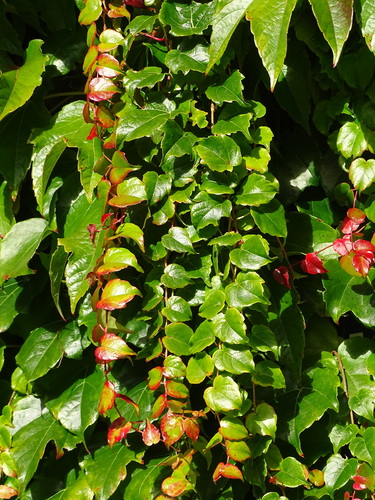
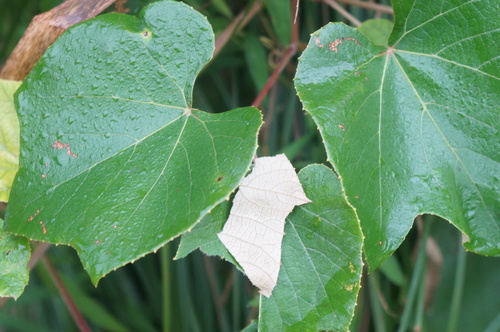
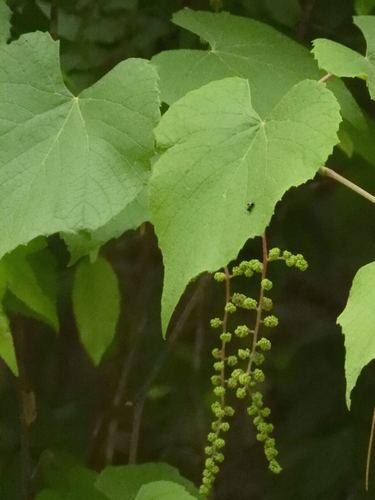
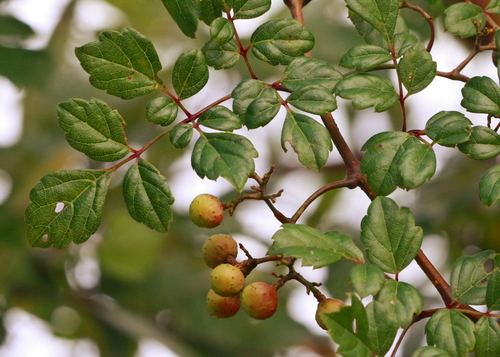
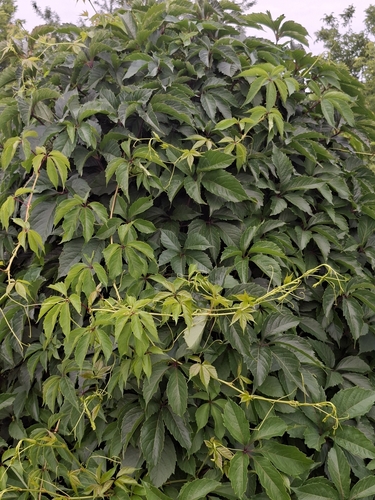
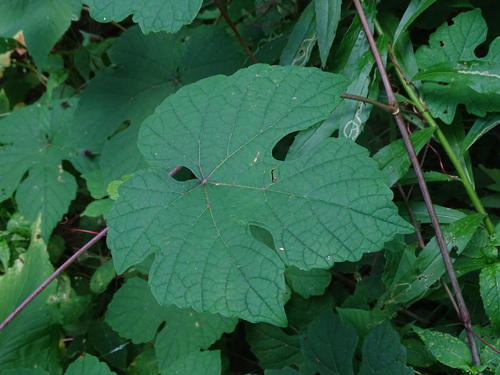
Vitis aestivalis, commonly known as the summer grape or pigeon grape, is a grape species native to eastern North America. Its native range extends from southern Ontario east to Maine, west to Oklahoma, and south to Florida and Texas. It is a vigorous vine that grows 10 meters or higher up trees. Its leaves are 7–20 cm long, suborbicular, and usually slightly broader than long; leaves vary in shape from unlobed to deeply three- or five-lobed, are green on the upper surface, and densely hairy on the lower surface. Flowers grow at every third node, arranged in a dense panicle 5–15 cm long. The fruit is a small grape 5–14 mm in diameter, with a dark purple or black colour. It is the official state grape of Missouri. Summer grape prefers drier upland habitat. Four varieties are recognized within the species: V. aestivalis var. aestivalis; V. aestivalis var. bicolor Deam (synonym var. argentifolia Fernald; common name Silverleaf Grape), formerly classified as Vitis bicolor, now accepted as a northern variant of Vitis aestivalis, native to the Northeastern United States and parts of Southern Ontario; V. aestivalis var. lincecumii (Buckley) Munson; and V. aestivalis var. bourquiniana L.H. Bailey, native to the southern region, sometimes treated as the separate species Vitis bourquiniana, which has tomentose undersides on its leaves. Several cultivars have been selected from this species. The cultivar 'Norton', which has significant V. aestivalis genetic background, is thought to be the oldest American grape cultivar still in commercial production. Interspecific hybrids developed with V. aestivalis, such as 'Norton', have demonstrated multiple useful traits for commercial wine production compared to other North American native grape varieties. These traits include lower acidity, a neutral 'vinifera-like' flavour profile, good tannin structure, and excellent disease resistance. Unlike most other species in the genus Vitis, V. aestivalis does not propagate well from dormant cuttings. This characteristic has limited its use in commercial viticulture, despite its favourable traits for winemaking. Propagation of V. aestivalis specimens typically must be done through layering or green cuttings. The species generally does not tolerate highly calcareous soils. There is a claim that a variety of V. aestivalis was cultivated by the Cherokees and used in some of their sacred rituals.