About Viscum combreticola Engl.
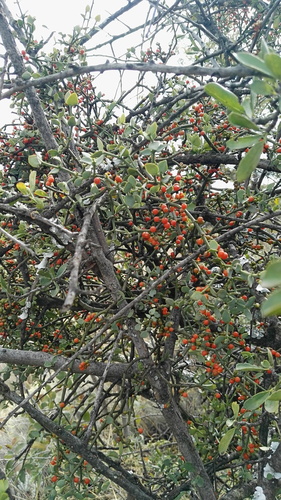
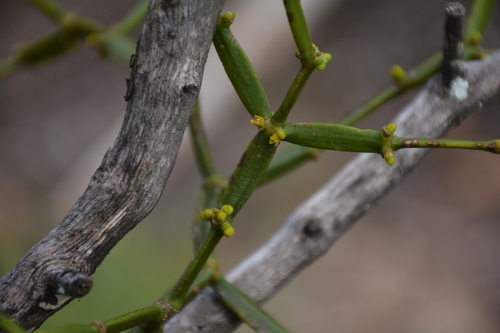
Viscum combreticola Engl., commonly called the Combretum mistletoe, is a leafless, dioecious mistletoe shrub. Its distribution ranges across a broad zone from southern Africa to tropical Africa, following the Rift Valleys. While it typically grows as a hemiparasite on species of the genus Combretum, it can also be found growing on a number of other host genera: Terminalia (from the Combretaceae family), Acacia, Croton, Diplorhynchus, Dombeya, Heteropyxis, Maytenus, Melia, Strychnos, and Vangueria. Its twigs are heavily branched, flattened, ribbed, and divided into distinct segments. The brittle olive to olive-green segments release watery sap when broken. Its sessile fruit, which usually grows in pairs, develops from the joints between segments. It forms ellipsoid berries 6 to 7 mm in diameter. These berries have a warty surface when young, becoming smooth and orange when ripe. This species resembles V. anceps in its vegetative form, and looks artificially similar to the Asian species V. dichotomum. Male inflorescences and fruit are required to distinguish it from V. shirense and V. cylindricum.