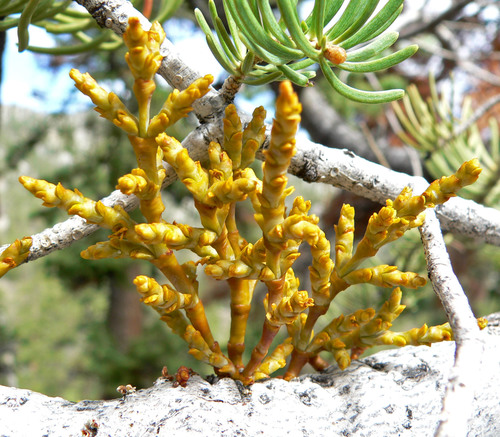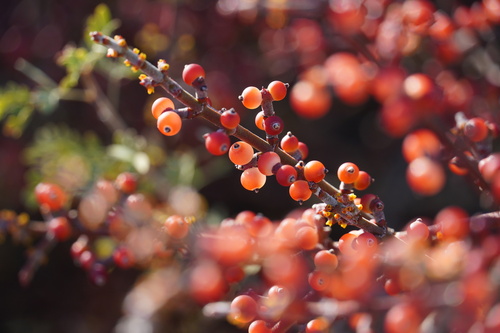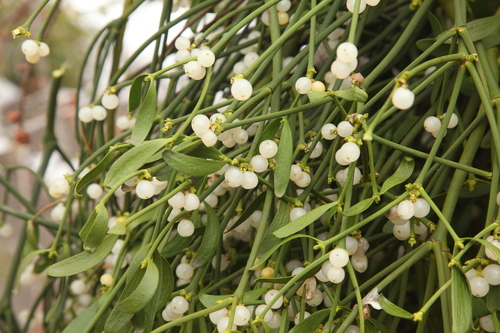
About Viscum album L.
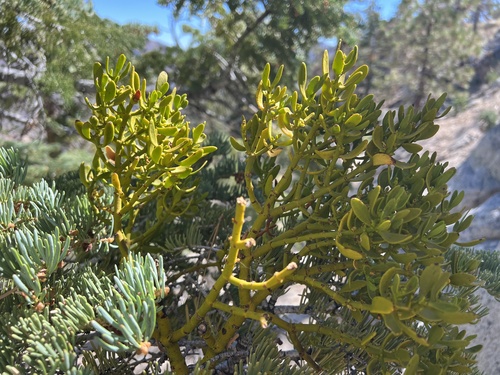
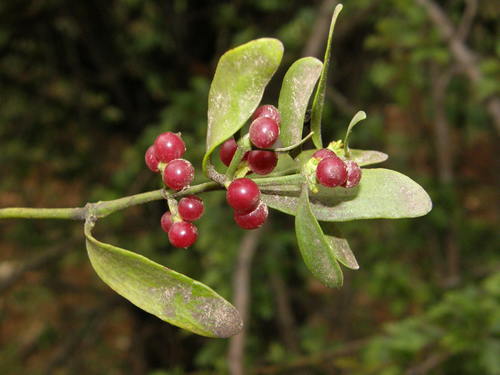
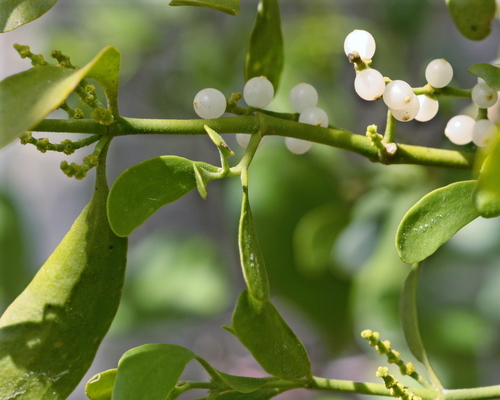
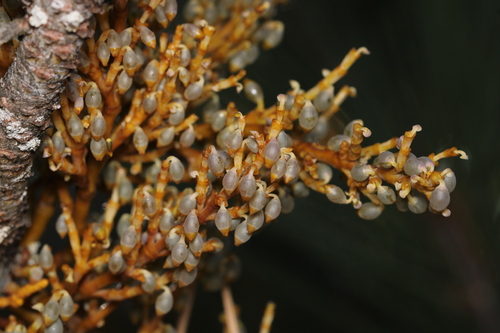
Viscum album L., commonly known as European mistletoe, is a hemi-parasitic evergreen shrub that grows on the stems of other trees. It produces a haustorium that connects its own xylem and phloem to that of its host tree, allowing it to obtain water and nutrients from the host. Its stems grow 30–100 centimetres (12–39 in) long, and have dichotomous branching. Its leaves grow in opposite pairs, are strap-shaped with smooth entire margins, have a leathery texture, measure 2–8 centimetres (0.79–3.15 in) long and 0.8–2.5 centimetres (0.31–0.98 in) wide, and are yellowish-green in colour. This species is dioecious; its insect-pollinated flowers are inconspicuous, yellowish-green, and 2–3 millimetres (0.079–0.118 in) in diameter. Its fruit is a white or yellow berry; almost always, the berry contains a single seed embedded in very sticky, glutinous fruit pulp. It most commonly grows in the crowns of broad-leaved trees, particularly apple, lime (linden), hawthorn, and poplar. European mistletoe is the only known multicellular organism that lacks a functioning respiratory complex I in its electron transport chain, a protein required to produce usable energy for its cells. It is thought to survive by obtaining adenosine triphosphate and other energy-rich compounds from its host, reorganizing its other respiratory complexes, slowing its growth, and reducing its energy requirements. If ingested in a concentrated form such as a herbal tea infusion, European mistletoe is potentially fatal. Eating its berries is known to cause serious illness in people. The toxic lectin viscumin has been isolated from Viscum album. Viscumin is a cytotoxic ribosome inactivating protein (RIP) that binds to galactose residues of cell surface glycoproteins, and may be taken into cells by endocytosis. It strongly inhibits protein synthesis by inactivating the 60 S ribosomal subunit. The structure of viscumin is very similar to other RIPs, with the closest resemblance to ricin and abrin. Some bird species have immunity to this toxin and feed on the plant's berries; this is especially true for the mistle thrush, which is named for mistletoe being its favourite food. Birds play a key role in dispersing the plant's seeds to new host tree locations. Herbalists use mistletoe leaves and young twigs to make preparations, which are popular in Europe, particularly in Germany, for attempts to treat circulatory and respiratory system problems. The use of mistletoe extract for cancer treatment originated with Rudolf Steiner, founder of Anthroposophy.