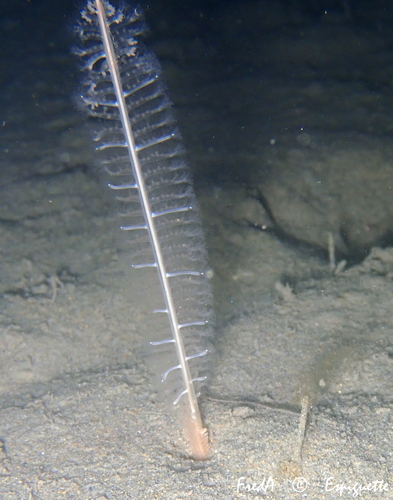
About Virgularia mirabilis (Müller, 1776)
Virgularia mirabilis, commonly called the slender sea pen, grows as upright, elongated, slender colonies in fine sediments. Its peduncle stays buried under the sediment, while its rachis extends into the water column. The species can withdraw very quickly into the sediment, and can reach a total length of up to 60 cm. Polyps grow on attached side branches, with up to 16 polyps per branch, and the central stem is only a few millimeters thick. Its color ranges from white and beige to light yellow, and it has a well-developed nerve net. This sea pen can live in shallow, sheltered areas and at depths down to 400 m. It occurs primarily in waters around Western Europe, and has also been found in the Mediterranean Sea and Mid-Atlantic Ocean. In the Mediterranean, it is mainly limited to the northern continental shelves. In the Mid-Atlantic, it has been recorded as far west as the Azores. It is common along all coasts of the British Isles, where it is one of the most abundant and widespread British sea pen species. This tolerance comes from its ability to tolerate a wide range of sediments, salinities, and temperatures. Surveys off the west coast of Scotland found it prefers salinities of 27 to 35, muddy sediments with a low gravel percentage, and depths between 5 and 200 m. Slender sea pens usually feed on zooplankton and other organic particles, but they also eat small animals swept into their branches. They have nematocysts, so they can engage in both passive predation on small animals and suspension feeding on particles. They are primarily passive carnivores, but will suspension feed when particles become trapped in mucus on the ends of their branches. Very few other fauna associate with this species, because its ability to retract into sediment makes it unsuitable for epizoic organisms to settle on. This species has separate sexes: each polyp colony is either male or female, and remains the same sex throughout its lifespan. Reproduction is annually episodic, occurring between June and October. Larvae can disperse up to 10 km. Little else is known about this species' reproductive cycles, but research on similar species suggests a single female colony can produce up to 200,000 eggs.

