About Virginia valeriae Baird & Girard, 1853
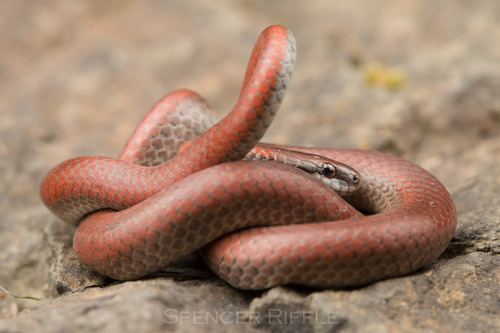
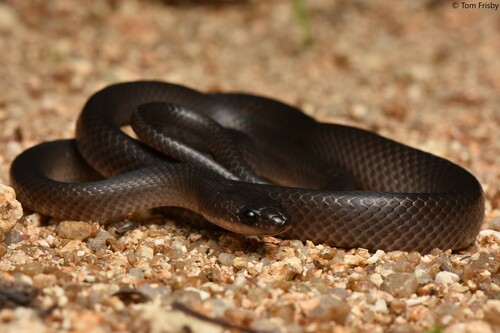
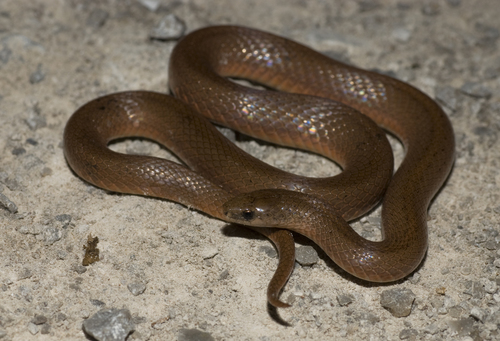
This description covers the scalation, coloration, size, geographic range, habitat, and reproduction of Virginia valeriae Baird & Girard, 1853, also called the smooth earth snake. For scalation: The rostral scale is nearly as deep as it is broad, and is visible when looking at the top of the head. The internasal scales are much shorter than the prefrontal scales. The frontal scale is longer than it is broad, and shorter than the parietal scales. The loreal scale is one and a half to two and a half times as long as it is deep. There are two or three postocular scales. The temporal scales follow a 1+2 arrangement. There are six upper labial scales, with the third and fourth making contact with the eye. Four lower labial scales contact the anterior chin shields, and the anterior chin shields are as long as or shorter than the posterior chin shields. Dorsal scales are arranged in 15 or 17 rows. The anal scale is divided. There are 111–135 ventral scales, and 24–37 subcaudal scales. The color description here is for a live, non-alcohol-preserved specimen, and follows the color naming system from Robert Ridgway's 1912 Color Standards and Color Nomenclature. Dorsally, V. valeriae can be benzo brown, deep brownish drab, mars brown, or light brownish drab. The first row of dorsal scales matches the color of the adjacent ventrals, which are light vinaceous-fawn, pale vinaceous-fawn, pale grayish vinaceous, or pale vinaceous-pink. The top of the head is hair brown, or matches the dorsal coloration, and has many dark spots on its head scales. The upper labials are ecru-drab or lighter, and some of these scales have drab-gray spots. A small black ring surrounds the eye. The ventral surface of the head is white. Sometimes a faint median light stripe is visible across the back. Tiny black spots may also appear on the back and sides, which is especially common in the nominate subspecies Virginia valeriae valeriae. Most adult smooth earth snakes measure 18–25 cm (7.1–9.8 in) in total length, including the tail, with a recorded maximum total length of 33.7 cm (13 1/4 in). The smooth earth snake's geographic range extends from Texas and Iowa in the west and north to New Jersey and Florida in the east and south. This is a small, fossorial species that spends most of its time buried in loose soil or leaf litter. V. valeriai is viviparous, giving birth to live young in August. Broods most often contain fewer than 10 offspring. Newborns measure approximately 6 cm (about 2.5 in) in total length.