About Vireolanius pulchellus P.L.Sclater & Salvin, 1859
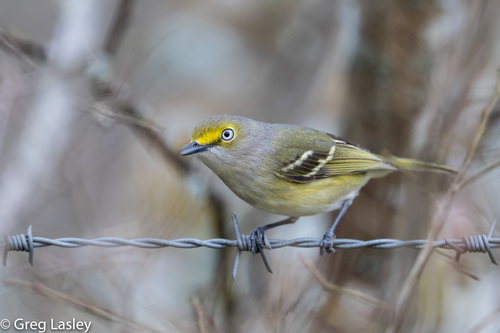
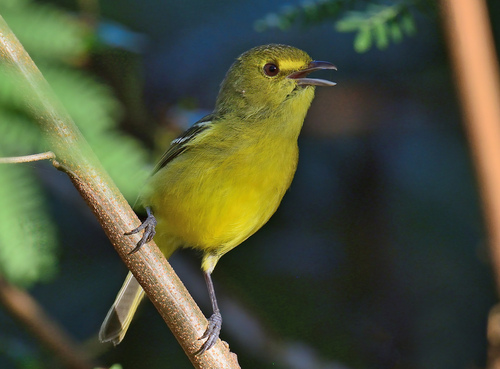
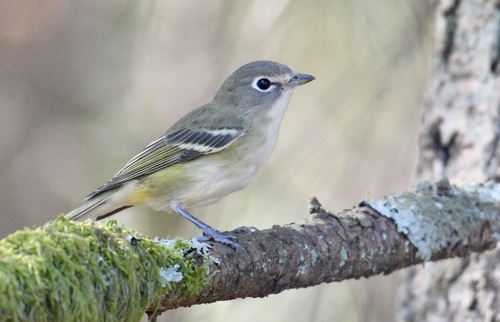
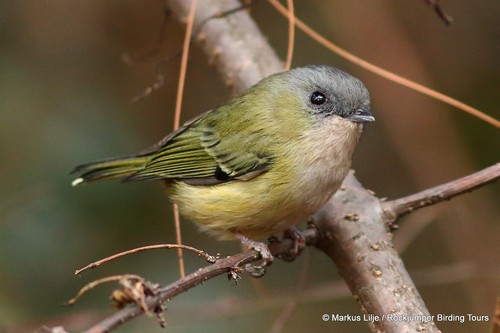
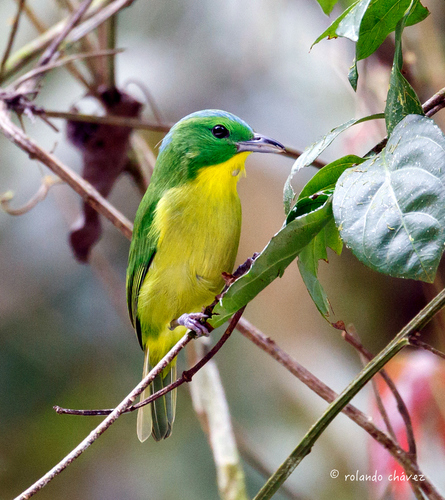
Vireolanius pulchellus, commonly called the green shrike-vireo, measures 12 to 15 cm (4.7 to 5.9 in) in length and weighs 22 to 30 g (0.78 to 1.1 oz). It is a bulky bird and a large species within its family. Adult males and females share the same plumage pattern. Adults have a cerulean blue crown and nape, with green coloring in the center of the crown. The sides of the head and all upperparts are bright green. The chin and throat are yellow, and most of the remaining underparts are light yellowish green. The green color is deeper on the flanks, and the undertail coverts are greenish yellow. This species has a brown iris, a black upper mandible, a light gray lower mandible with a darker base, and gray legs and feet. Juveniles are mostly olive-green on their upperparts and dull yellowish on their underparts. They have a bold yellow supercilium and two yellow wing bars. Four subspecies are recognized, each with distinct plumage traits: V. p. ramosi has a mostly to entirely blue head and nape, and its breast, sides, and flanks are a clearer, less greenish yellow than those of the nominate subspecies V. p. pulchellus. V. p. verticalis has a mostly green head, with blue coloring only on the forehead and hindneck. V. p. viridiceps has a green head, with blue coloring only on the hindneck. Each subspecies of green shrike-vireo has a separate geographic range: V. p. ramosi occurs in southeastern Mexico, ranging from Veracruz east to Quintana Roo and south to Oaxaca. V. p. pulchellus is found on the Gulf/Caribbean slope from Campeche and Quintana Roo in southeastern Mexico, south through Belize, eastern Guatemala and eastern Honduras into northern Nicaragua; it also occurs intermittently on the Pacific slope of Chiapas, western Guatemala, and northern El Salvador. V. p. verticalis occurs on the Caribbean slopes of Nicaragua, Costa Rica, and western Panama, extending to eastern Veraguas Province. V. p. viridiceps is found on the Pacific slope from the southern Gulf of Nicoya in Costa Rica into western Panama, and on the Caribbean slope of central Panama to Panamá Province. The green shrike-vireo inhabits the interior and edges of humid evergreen and semi-deciduous forest in tropical and lower subtropical zones. In terms of elevation, it ranges from sea level to 1,800 m (5,900 ft) in Mexico and northern Central America, and up to 1,200 m (3,900 ft) in Costa Rica.