About Vireo vicinior Coues, 1866
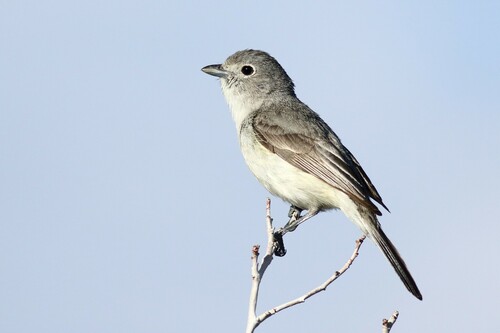
The gray vireo (Vireo vicinior Coues, 1866) measures about 13 to 15 cm (5.1 to 5.9 in) long and weighs 11.5 to 13.5 g (0.41 to 0.48 oz). Males and females have identical plumage. Adults have mostly gray crowns and faces, with white lores and a thin white eye-ring. Their upperparts are gray, which develops a greenish tint later in the year. Their wings are mostly dark gray to blackish, with white tips on the greater coverts that form a single wing bar. Their tail is gray, with white edges along the outer webs of the outermost feathers. Their chin, throat, and upper breast are a paler gray than their upperparts, while their belly and undertail coverts are white. They have a dark brown iris, a plumbeous or blackish upper mandible (maxilla), a paler grayish blue lower mandible, and plumbeous or blue-gray legs and feet. The gray vireo has a disjunct distribution across both its breeding and wintering ranges. Its main breeding range spans the southwestern United States, roughly bounded by far southeastern California, northeastern Utah, northwestern Colorado, central New Mexico, and southwestern New Mexico and southeastern Arizona. It also breeds in several small separate areas: south-central California, southeastern Colorado, southeastern New Mexico, southwestern Texas, and northern Baja California. It winters in southern Baja California and from southwestern Arizona south through most of the Mexican state of Sonora. A year-round resident population exists in the Big Bend region of southwestern Texas. The species has also been recorded as a vagrant in Kansas, Oklahoma, Wyoming, and Wisconsin. Year-round, the gray vireo lives in a range of dry landscapes, including oak-juniper woodlands, pinyon-juniper woodlands, chaparral, and thorn scrub. During migration and on its wintering grounds, it also occupies arid and desert scrublands. Across most of its breeding range, it occurs at elevations between approximately 1,600 and 2,300 m (5,200 and 7,500 ft). It can be found at lower elevations: as low as 900 m (3,000 ft) in west Texas and 400 m (1,300 ft) in northern Mexico.