About Vireo solitarius (A.Wilson, 1810)
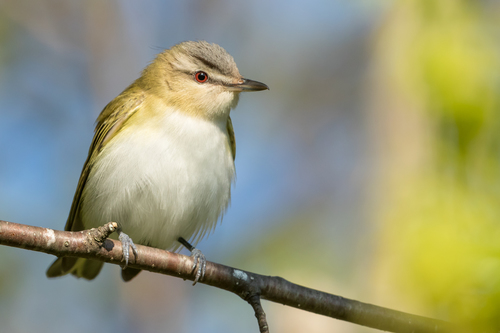
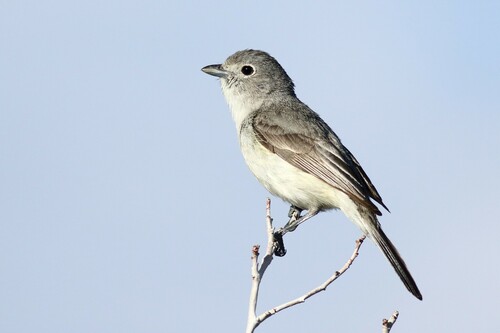
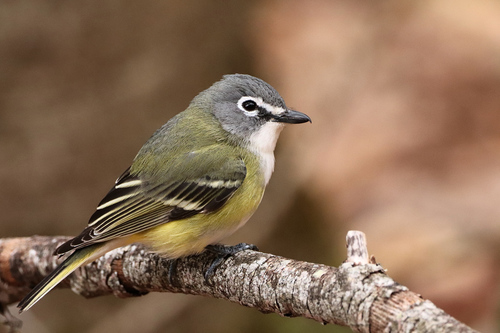
The blue-headed vireo, Vireo solitarius, retains the same plumage year-round, with no drastic change in appearance during the breeding season. It can be identified by its olive-green upper body, two bold yellow wing bars along the edge of each wing, and a deep blue-grey crown that gives the species its common name. Immature blue-headed vireos have juvenile plumage that is not distinct, and closely resembles adult plumage. While this species looks similar to its close relative the Cassin's vireo (Vireo cassinii), Cassin's vireos can be told apart by their lighter yellow patches, smaller thinner bill, and brownish-grey crown. There is little to no sexual dimorphism between male and female blue-headed vireos; both have similar plumage coloration and share a similar size range. Like most vireos, the blue-headed vireo is a relatively small bird, measuring 126–148 mm (5.0–5.8 in) in length. It typically has a wingspan of around 200–240 mm (7.9–9.4 in) and weighs 13–19 g (0.46–0.67 oz). There are subtle differences between the two recognized subspecies, V. s. solitarius and V. s. alticola. V. s. alticola is the larger of the two, with a darker back, a wing length of 76–83.5 mm (2.99–3.29 in), and a bill length of 11–12 mm (0.43–0.47 in). In contrast, V. s. solitarius is slightly smaller, with a wing length of 69.2–77.8 mm (2.72–3.06 in), and a bill length of 8.9–11 mm (0.35–0.43 in). The average recorded lifespan of the blue-headed vireo in the wild is approximately 7 years and 5 months. Blue-headed vireos are native to North America, with a large breeding range covering a vast area of Canada and the northern United States. The breeding range of V. s. solitarius stretches from northeastern British Columbia across Alberta, Saskatchewan, Manitoba, Ontario, and Quebec, and extends south to southern Pennsylvania and New Jersey. V. s. alticola has a separate breeding range that includes western Maryland and extends south, mainly along the Appalachian Mountains, to northern Georgia. At the end of the breeding season, blue-headed vireos migrate south to their overwintering grounds. Of the two subspecies, V. s. solitarius makes the longest migration, and overwinters in an area spanning eastern and southern Mexico to northern Central America. V. s. alticola migrates a shorter distance, to an overwintering area that extends from southeastern Virginia to Texas. Blue-headed vireos prefer to breed in cool temperate forests, which are found at higher elevations in the southern portion of their breeding range. Their preferred habitat is evergreen forest with spruce, fir, hemlock, and pine mixed with deciduous growth such as alder shrubs, willow shrubs, poplar, birch, or maple trees. During the winter, blue-headed vireos live in mixed pine and hardwood woods. They are also found in coastal and floodplain swamps, and low shrubby thickets. Population density is somewhat low and spread out year-round, even during the breeding season. Overwintering population density is usually lower than breeding season density, and overall population density depends on the type of forest the birds inhabit. During migration, blue-headed vireos often flock with different sparrow species, and rarely flock with other members of their own species. When blue-headed vireos arrive at their breeding grounds, typically in mid-April, many deciduous trees have not yet leafed out, so the birds nest in evergreen trees including hemlocks (Tsuga). In recent years, large numbers of hemlocks in the eastern United States have been killed by the invasive Asian insect the hemlock woolly adelgid (Adelges tsugae), leaving blue-headed vireos with fewer nesting options until deciduous trees leaf out in spring. Males arrive at breeding grounds in mid-April and establish large individual territories ranging from 1.5–6.6 hectares (3.7–16.3 acres). Females choose a mate based on the male's ability to defend and hold a large territory. While defending their territories from other males, males sing a primary song to attract females. Undecided females often fly along the edges of competing male territories, which usually leads to direct conflict between the two males for the right to mate with the female. Once a female approaches a suitable male, the male performs a series of mating rituals. These rituals typically involve the male building a courtship nest for the female. This courtship nest is not a complete nest, and is thought to be a display of the male's ability to gather resources. After a pair is formed, the courtship nest is abandoned. Mating does not occur for roughly two weeks after the pair is established. During this time, the male and female work together to build a breeding nest, which is typically built between forking mid-level branches of evergreen or deciduous trees and made from twigs and foliage. Breeding nests are not reused in later breeding seasons. In one breeding season, a female lays 3–5 eggs at a rate of 1 egg per day. The eggs are creamy white with brown or black spots, and measure 17–23.1 x 13.3–15.8 mm. Incubation of the eggs lasts approximately 14 days after laying. When they hatch, chicks are highly altricial, usually with little to no downy feathers. Chicks open their eyes on day 5 or 6 after hatching, and fledge 14 days after hatching, for a total chick-rearing period of 28 days. Once the young can leave the nest, the parents split the juveniles between them and separate. Juveniles usually depend on their parent for food for around one month after leaving the nest. If a nest is destroyed or a brood fails, the pair may attempt to re-nest, but this depends on when the failure happens. If the brood fails early in the breeding season, the pair is much more likely to re-nest; if it fails later, the pair usually separates and does not attempt a second brood. The blue-headed vireo has an unusual breeding strategy compared to its close relatives. Males help their mates with daytime egg incubation, nest construction, and feeding chicks. Also unlike most bird species, female blue-headed vireos do not seek extra-pair copulations with other males. Males also do not attempt to guard females from other males, making blue-headed vireos both socially and genetically monogamous.