About Vireo plumbeus Coues, 1866
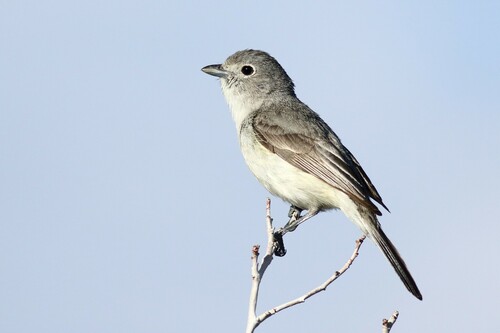
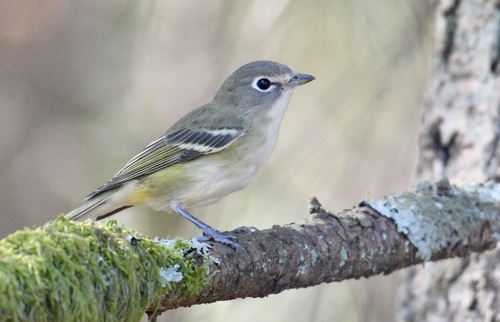
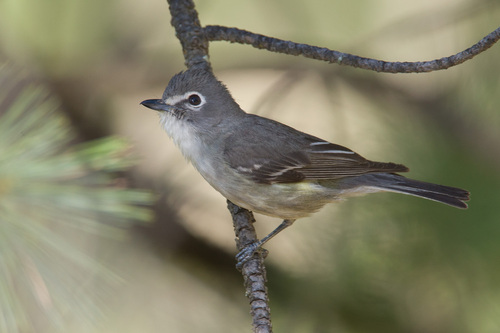
Vireo plumbeus, commonly known as the plumbeous vireo, measures 12.4 to 13.8 cm (4.9 to 5.4 in) in length and weighs approximately 12 to 20 g (0.42 to 0.71 oz). Males and females have identical plumage. Adults of the nominate subspecies V. p. plumbeus have a neutral gray crown and nape, a wide white stripe above the lores, a wide white eye-ring crossed by a dusky stripe, and neutral gray ear coverts. Their upperparts are neutral gray with an olive-green tinge on the rump. Their wing coverts are blackish gray with whitish tips that form two distinct wing bars. Their flight feathers (remiges) are blackish gray with pale olive gray edges. Their tail feathers (rectrices) are blackish gray, with the outermost pair having wide white edges. Their underparts are mostly nearly white, with smudgy pale grayish olive on the sides of the breast, and some individuals have very pale sulfur yellow coloring on the flanks. Subspecies V. p. gravis is larger than the nominate subspecies, with a darker crown and more olive (less gray) edges on its secondaries. Subspecies V. p. notius is mostly similar to the nominate, though some individuals have a somewhat greener back and yellower flanks. Subspecies V. p. montanus has a blue-gray crown, a greenish back, and greenish yellow flanks. All subspecies have a brown iris, a black bill with a grayish base to the lower mandible, and bluish gray legs and feet. The plumbeous vireo has a disjunct distribution, with each subspecies occupying a separate range. V. p. plumbeus ranges from west-central United States (southeastern Montana, southwestern South Dakota, south-central Idaho, northeastern Utah, and Wyoming) south through Nevada, eastern California, Arizona, western Colorado and New Mexico, and extreme western Texas into Mexico, reaching as far south as Guerrero and south-central Oaxaca. V. p. gravis is found in east-central Mexico, in Hidalgo, western Veracruz, and Puebla. V. p. notius occurs only in Belize. V. p. montanus ranges from southeastern Oaxaca and Chiapas in southern Mexico south through central Guatemala and Honduras into northern Nicaragua. The species has also been recorded casually or accidentally in Oregon, Louisiana, and a small number of other locations. The plumbeous vireo lives in a variety of landscapes across temperate and subtropical zones. In the United States, it primarily inhabits coniferous and mixed pine-oak forests, including those dominated by ponderosa pine (Pinus ponderosa), as well as piñon-juniper woodlands. It also occurs in riparian woodlands. Further south in Mexico, it is mostly found in pine-oak woodlands and oak scrublands. During migration and overwintering, it uses a wider range of habitats, adding gallery forest, mangroves, plantations, evergreen forest, and thorn forest. In Belize, Guatemala, and Honduras, it inhabits pine-oak forest and pine savanna. Within its breeding range, it occurs at elevations between 1,150 and 2,500 m (3,800 and 8,200 ft). In Mexico, it can be found from sea level up to 3,000 m (9,800 ft). In Central America, it mostly occurs above 600 m (2,000 ft), with the exception of eastern Honduras where it is found at or below 300 m (1,000 ft).