About Vireo pallens Salvin, 1863
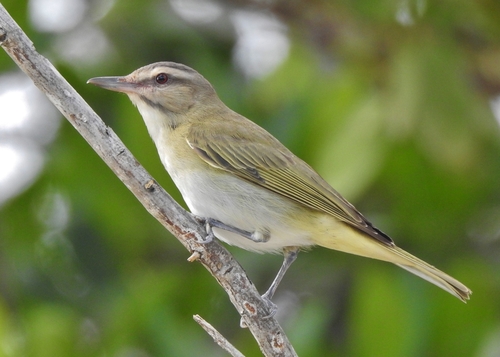
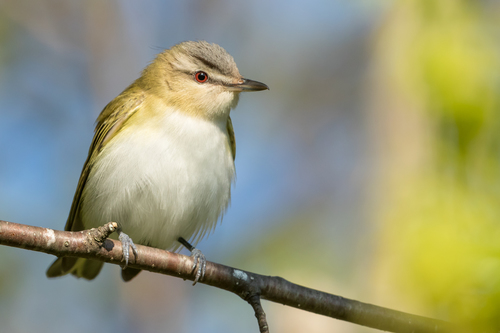
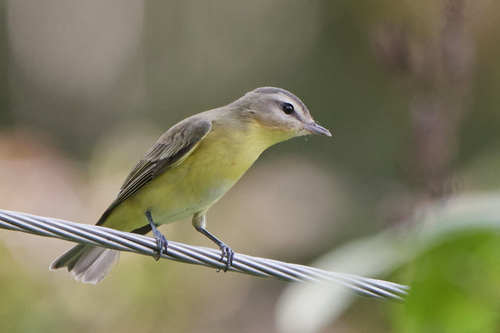
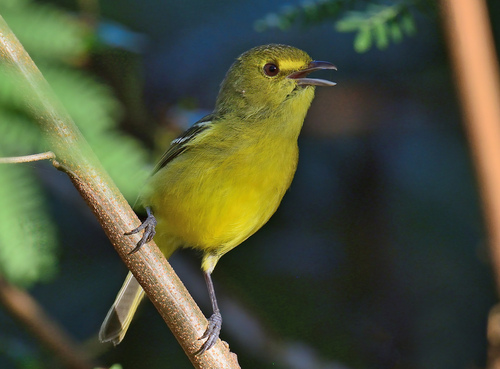
The mangrove vireo (Vireo pallens Salvin, 1863) measures 11 to 12 cm (4.3 to 4.7 in) in length and weighs approximately 9 to 13 g (0.32 to 0.46 oz). Males and females have identical plumage. Adults of the nominate subspecies V. p. pallens have mostly greenish brown crowns, faces, and napes, with a buffy area extending from above the lores to past the eye. Their upperparts are greenish brown. Their wing coverts are dark gray with yellowish white tips that form two distinct wing bars. Their flight feathers are dark gray: the primaries and secondaries have thin yellowish green edges along their outer webs, and the tertials have whitish edges. Their tail is dark gray, with greenish edges on the outer webs of the feathers. Their chin is whitish yellow, and their throat and underparts are grayish, with a faint yellow tinge on the lower flanks and belly. The other subspecies of mangrove vireo differ from the nominate subspecies and from each other as follows: V. p. paluster is larger than the nominate and has yellower underparts; V. p. semiflavus has brighter greenish upperparts and brighter yellow underparts than all other subspecies; V. p. ochraceus matches the nominate in appearance but has a dull yellow iris; V. p. salvini is smaller and paler than the nominate, with greenish olive upperparts and yellowish underparts; V. p. wetmorei matches V. p. semiflavus in appearance; V. p. angulensis is smaller than the nominate, with brownish drab cheeks and a pale olive back with a drab brownish wash; V. p. browningi matches V. p. semiflavus in appearance; V. p. nicoyensis is paler and duller overall than other subspecies, with an almost pure white throat and belly and highly variable iris color ranging from light brown to white; V. p. approximans has a yellowish breast and a larger, wider bill than other subspecies. Across all subspecies, the iris ranges from brownish straw to dirty white, the maxilla is dark brown or gray brown, the mandible is paler, and the legs and feet are gray-blue. The mangrove vireo has a widely disjunct distribution, with each subspecies occupying a separate range: V. p. paluster is found in coastal northwestern Mexico, from southwestern Sonora south to Nayarit; V. p. semiflavus ranges from northern Guatemala and southern Belize south across northern Honduras into eastern Nicaragua, reaching Bluefields; V. p. ochraceus ranges from southern Oaxaca in southwestern Mexico south along the Pacific coast through Guatemala into El Salvador's Usulután Department; V. p. salvini is found on the Yucatán Peninsula of southeastern Mexico and in northern Belize; V. p. pallens is found in southern Honduras, western Nicaragua, and western Costa Rica; V. p. wetmorei occurs on Isla El Cayo off eastern Guatemala; V. p. angulensis occurs on the Bay Islands off northern Honduras; V. p. browningi is found in southeastern Nicaragua; V. p. nicoyensis occurs on the Nicoya Peninsula and around the Bay of Nicoya in northwestern Costa Rica; V. p. approximans occurs on Isla de Providencia and Isla Santa Catalina off the east coast of Nicaragua. The mangrove vireo occupies different habitats on the Pacific and Caribbean sides of Central America. The Pacific subspecies V. p. paluster, V. p. ochraceus, V. p. pallens, and V. p. nicoyensis are found almost exclusively in mangroves, especially red mangrove (Rhizophora). The other subspecies, which occur along the Caribbean coast and nearby islands, inhabit a wider range of landscapes. In addition to mangroves, these include scrubby woodlands, overgrown fields with bushes, young secondary forest, and the edges of more mature forest.