About Vireo olivaceus (Linnaeus, 1766)
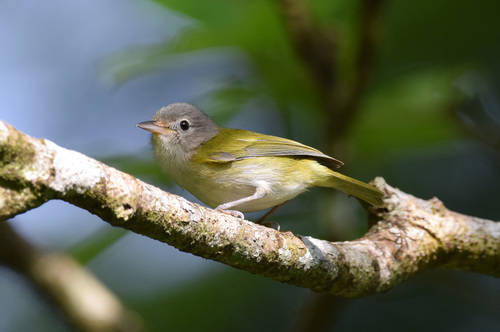
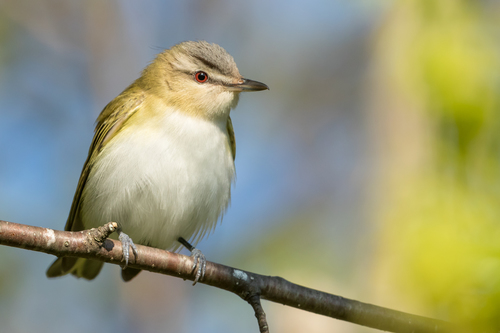
Adult red-eyed vireos are mainly olive-green on their upper bodies and white on their underparts. They have a red iris, a grey crown bordered by black, a dark blackish line running through the eyes, and a wide white stripe directly above this eye line. Their legs are thick and blue-grey, and they have a stout bill. The flanks and undertail coverts are yellowish, though this yellow tint is faint in some populations. Historically, the yellow-green vireo (V. flavoviridis), chivi vireo (V. chivi), and Noronha vireo (V. gracilirostris) were classified as the same species as the red-eyed vireo; the chivi vireo was the most recent of these to be split into a separate species. Other close relatives of the red-eyed vireo include the black-whiskered vireo (V. altiloquus) and the Yucatan vireo (V. magister). For both sexes, the red-eyed vireo measures 12–13 cm (4.7–5.1 in) in length, weighs 12–26 g (0.4–0.9 oz), and has a wingspan of 23–25 cm (9.1–9.8 in). The breeding range of the red-eyed vireo covers open wooded areas across Canada, as well as the eastern and northwestern United States. These northern breeding populations migrate to South America to spend the winter. Latin American populations of red-eyed vireo live in almost any wooded habitat within their range. Most of these Latin American populations are non-migratory residents, but populations that breed in the far southern part of the species' range including most of its range in Argentina, Uruguay, Paraguay and Bolivia migrate north as far as Central America. In northern Ohio, red-eyed vireos currently return to breeding grounds around the same time they did one century ago, but now leave for wintering grounds one to two weeks earlier than they did in the past. Red-eyed vireos glean insects from tree foliage, preferring caterpillars and aphids, and sometimes hover while foraging. In some tropical regions, they regularly join mixed-species feeding flocks, and forage higher up in the trees than most members of these flocks. They also eat berries, especially before migration and in their wintering ranges. Fruit-producing trees favored by red-eyed vireos such as tamanqueiro (Alchornea glandulosa) and gumbo-limbo (Bursera simaruba) will even draw the birds to parks and gardens. Unlike foraging for insects, they do not pick fruit while hovering; instead, they reach for fruit in often quite acrobatic positions, even hanging upside down. The red-eyed vireo builds a cup-shaped nest in the fork of a tree branch. In the northern part of its range, the red-eyed vireo experiences nest parasitism from the brown-headed cowbird (Molothrus ater), while the shiny cowbird (M. bonariensis) causes nest parasitism further south. Studies of birds caught in Parque Nacional de La Macarena and near Turbo, Colombia noted that infection with Haemoproteus and trypanosoma is very common among red-eyed vireos: all three of the individuals examined in the study were infected with at least one of these parasites.