About Vireo magister (S.F.Baird, 1871)
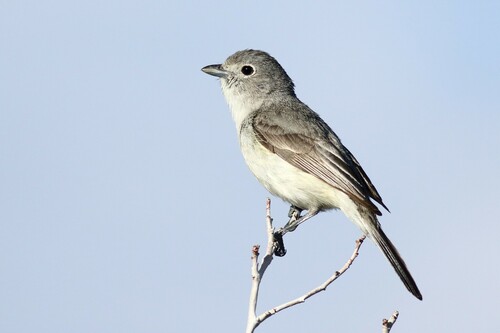
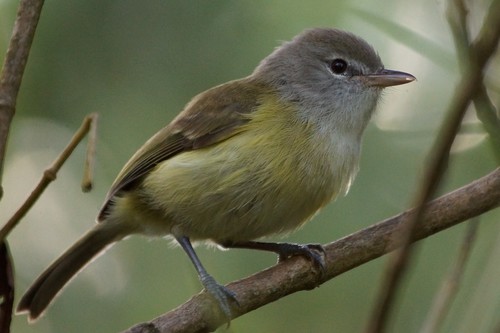
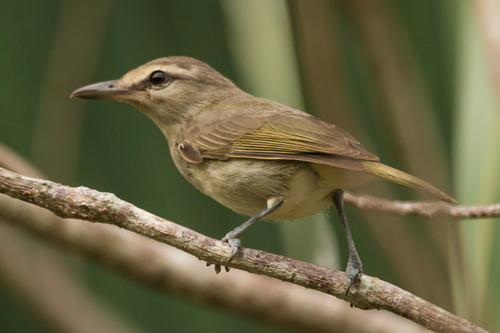
The Yucatan vireo (scientific name Vireo magister, originally described by S. F. Baird in 1871) is approximately 15 cm (5.9 in) long and weighs between about 13.5 and 25 g (0.48 to 0.88 oz). Males and females have identical plumage. Adult individuals of the nominate subspecies V. m. magister have a pale brownish white supercilium and brownish gray lores, and the brownish gray color extends to behind the eye. The crown, nape, and upperparts of the nominate adult are dark gray-brown, with an olive tinge on the back. The primaries and secondaries are blackish gray, with thin paler olive edges along the outer webs. The tail is dark brownish gray. The throat and center of the breast are buffy white, the sides of the breast are grayish, the center of the belly and the vent are white, and the flanks and sides are grayish with an olive wash. Nominate adults have a blackish iris, a stout gray bill with a paler gray base to the mandible, and bluish or blue-gray legs and feet. Subspecies V. m. decoloratus is larger than the nominate subspecies, with a longer bill and tail, a dark grayish crown, and paler, more whitish underparts. V. m. stilesi has a brighter, more olive-green rump and brighter, more olive-green edges on the flight feathers than the nominate subspecies. V. m. caymanensis is the smallest subspecies; it has olive upperparts with a somewhat brighter rump and slaty brown feet. The Yucatan vireo has a disjunct distribution across its four subspecies. The nominate subspecies has the largest range of the four, occurring in southeastern Mexico's Quintana Roo, including Mujeres and Cozumel islands, and extending south along the coast of Belize. Subspecies V. m. decoloratus occurs on islands off northern and central Belize. V. m. stilesi occurs on islands off southern Belize and northern Honduras. V. m. caymanensis occurs on Grand Cayman. There is also a well-documented record of a vagrant individual at High Island, Texas, in 1984. The Yucatan vireo lives in a variety of tropical zone landscapes, including deciduous forest, secondary forest, mangrove forest, and scrubby coastal woodlands. In Belize, it also lives in thickets in pine stands on ridges, and on Grand Cayman it lives in forest growing on limestone soils.