About Vireo latimeri S.F.Baird, 1866
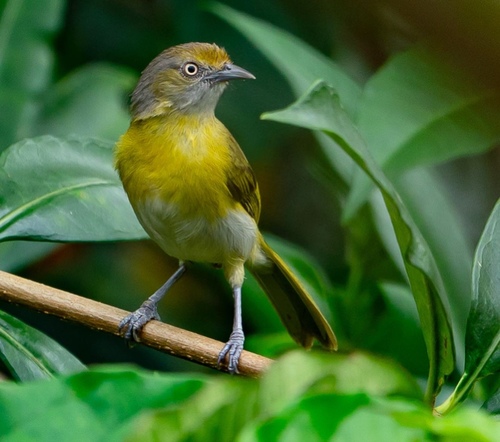
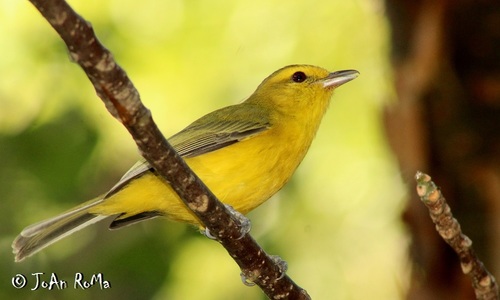
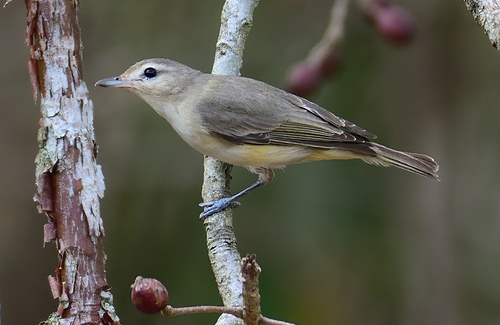
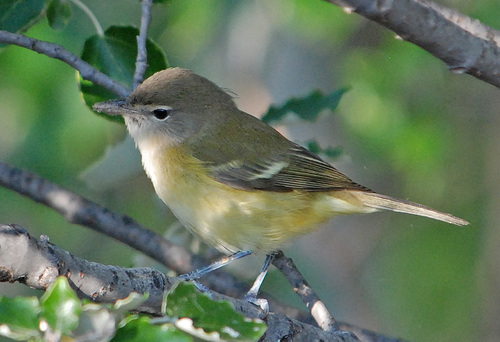
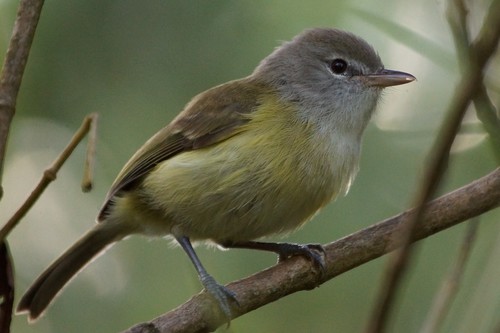
The Puerto Rican vireo (Vireo latimeri S.F.Baird, 1866) is a small bird endemic to the archipelago of Puerto Rico, and one of 31 species in the genus Vireo of the family Vireonidae. Its local name is bien-te-veo, which translates to "see-you-well" and is named after its call; it is not to be confused with the unrelated great kiskadee, which is also called bien-te-veo and found elsewhere. The Puerto Rican vireo has a gray head, a white breast, and a yellowish belly. On average, the species measures 12 cm (4.72 in) long and weighs between 11 and 12 grams (0.388–0.423 oz). It inhabits various forested areas across all elevations in Puerto Rico, including wet forests, dry forests, and mangroves, and has also been recorded living in shade coffee plantations. Breeding occurs from March to July, during which females lay clutches of 2–3 pale pink eggs with brown spots. Typically, breeding pairs only have enough resources to successfully raise one chick, and both parents share equal responsibility for chick care, including gathering food and defending the nest from other birds. The Puerto Rican vireo is an insectivore; its diet consists primarily of grasshoppers, caterpillars, cicadas, beetles, and aphids, and is supplemented with spiders, anoles, and berries. From 1973 until at least 1996, the species experienced a population decline in Guánica State Forest, with the primary cause identified as brood parasitism by the introduced shiny cowbird (Molothrus bonariensis). One study conducted from 1973 to 1996 measured Puerto Rican vireo survival rates using mist netting in the 4000-hectare Guánica Forest. The lack of captures in six of the final ten years of the study was interpreted as evidence of a 5% population decrease. One net line recorded a drop from 27 captures in 1989 to just 8 captures in 1995. Annual survival rate for the original net line fell from 0.68 in the 1973–1990 period to 0.61 when extending data collection through 1996. Analysis found that after 1994, the annual survival rate dropped further to 0.54. This pattern suggests the population is experiencing either increased emigration or increased mortality. Up to 83% of Puerto Rican vireo nests were found to be parasitized by shiny cowbirds, which caused an 82% reduction in the number of fledglings. This decline was not observed in other local insectivorous birds such as the Puerto Rican flycatcher (Myiarchus antillarum) and Adelaide's warbler (Setophaga adelaidae), confirming brood parasitism as the main driver. Additional threats to the species include competition for nesting sites with other birds, predation by introduced mongooses and cats (brought to the island to hunt rats), deforestation, and the removal of shade coffee plantations that destroy their habitat and displace populations. The population has declined consistently over 20 years. Overall annual survival rate for the Puerto Rican vireo is 0.74, and the survival rate for first-fledged juveniles is 0.40. The recorded longevity record for the species is 13 years and 2 months, documented via banding and recapture. One study with a sample of 51 males, 14 females, 13 fledglings, and 10 individuals of unknown sex recorded a recapture rate of 0.92 for males. After Hurricane Georges, a study found overall nest survival of 0.932, but recorded a 26% decrease in the density of territorial males in the year after the hurricane. The return rate of color-marked adults was 39% in the hurricane year, compared to 72% in a non-hurricane year. Genetic analysis using random amplified polymorphic DNA markers compared genetic diversity across multiple vireo species. The mainland white-eyed vireo (Vireo griseus) had much higher genetic diversity, with 67% of markers found to be polymorphic. In contrast, endemic island vireo species had lower polymorphism: the Puerto Rican vireo had 38%, the Jamaican vireo (V. modestus) had 34%, and the Blue Mountain vireo (V. osburni) had 32%.