About Vireo hypochryseus P.L.Sclater, 1863
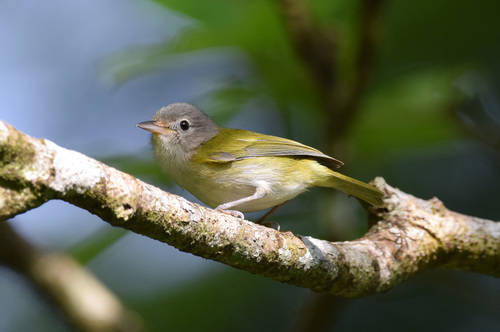
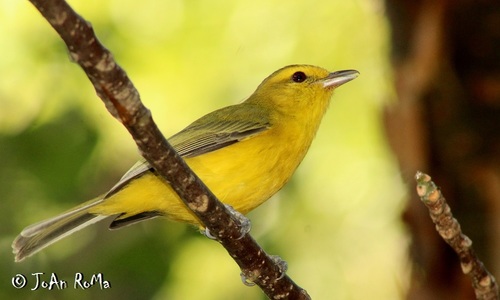
The golden vireo (scientific name Vireo hypochryseus P.L.Sclater, 1863) measures about 12 to 13 cm (4.7 to 5.1 in) long and has an average weight of 12.2 g (0.43 oz). Males and females have identical plumage. Adult golden vireos have a wide lemon yellow supercilium, a streak above the lores, and a dark stripe running through the eye. Their upperparts and tail are yellowish olive-green. Their flight feathers are dark brownish gray with pale yellowish olive edges; the edges of the outer primaries lighten to pale gray or grayish white. Their underparts are lemon yellow, with a pale olive green tinge on the flanks. They have a dark brown iris, a pinkish gray bill, and blue-gray legs and feet. Juveniles have paler underparts than adults, and their crown and upperparts have a brown wash. Of the three recognized subspecies, V. h. nitidus has brighter yellow underparts than the nominate subspecies, with little to no olive coloring on the flanks. V. h. sordidus has darker olive-green upperparts that are less yellowish than the nominate, plus dingier, more greenish yellow underparts, and a dark horn-colored bill. The golden vireo is endemic to western Mexico. The nominate subspecies has the largest range of the three, occurring from Sinaloa south to Oaxaca. Subspecies V. h. nitidus is found only in the northwestern Mexican state of Sonora. Subspecies V. h. sordidus occurs only on the Tres Marías Islands off the coast of Nayarit. This species lives in deciduous forest, gallery forest, arid to semi-humid scrublands, and tropical zone plantations. Sources do not agree on the species' maximum elevation, with reported limits ranging from 1,000 m (3,300 ft) to 2,000 m (6,600 ft).