About Vireo huttoni Cassin, 1851
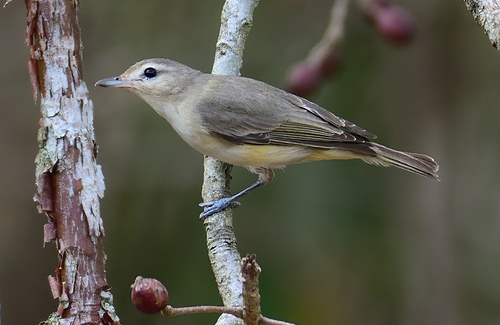
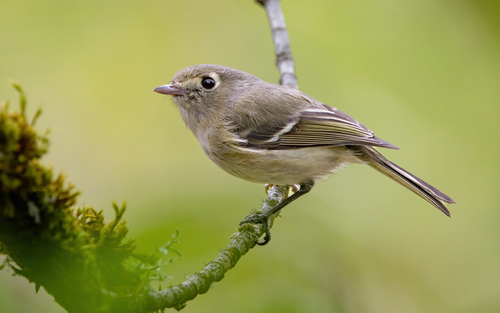
Hutton's vireo (Vireo huttoni Cassin, 1851) measures 10 to 12 cm (3.9 to 4.7 in) in length and weighs approximately 9 to 15 g (0.32 to 0.53 oz). Males and females have identical plumage. Adults of the nominate subspecies V. h. huttoni have an olive crown and nape, pale lores, a wide broken pale whitish eye-ring, and pale olive ear coverts. Their upperparts are olive, becoming greener on the rump. Their wing coverts are dusky olive with wide pale yellowish olive tips that form two distinct wing bars. Their flight feathers (remiges) and tail feathers (rectrices) are dusky brownish to blackish, with pale yellowish olive edges along their outer webs. Their underparts are yellowish white with a pale buff to grayish olive wash. Plumage across Hutton's vireo subspecies generally follows Gloger's Rule: the palest, most yellowish birds occur in the northern part of the range, and birds become gradually grayer and darker further south. Differences between non-nominate subspecies and the nominate, and between the subspecies themselves, are as follows: V. h. obscurus has a bright greenish olive crown, nape, and back, yellowish eye-ring and wing bars, olive-buff flanks, and buff-yellow underparts. V. h. parkesi is similar to obscurus but has more yellowish (less greenish) upperparts, a brighter rump, and brighter yellow underparts. V. h. sierrae has a pale grayish crown and nape, pale yellow-green back, and yellowish white underparts. V. h. oberholseri has a slate-gray crown and nape, pale olive edges on the rectrices, and whiter underparts than the nominate. V. h. unitti has a dusky olive back, grayish wing bars, olive edges on the rectrices, and olive-gray flanks. V. h. cognatus has a grayish olive back and pale buff-yellow underparts. V. h. stephensi is paler overall than the nominate, with an olive gray back, yellowish white eye-ring, wing bars, and rectrix edges, and olive-buff underparts. V. h. carolinae is similar to stephensi but has a darker and greener crown, nape, and back. V. h. pacificus is darker overall than stephensi, with richer, more yellowish crown, rump, and rectrix edges. V. h. mexicanus is the darkest subspecies; it has an olive-gray to olive-brown back, and darker underparts on the breast, sides, and flanks than on the belly. V. h. vulcani is similar to mexicanus but is richer colored overall, with a greener crown. All subspecies have a dark brown iris, a blackish to pale brown upper mandible (maxilla), a paler lower mandible, and blue-gray to dark gray legs and feet. Hutton's vireo has a disjunct distribution. The ranges of the "Pacific" group of subspecies are contiguous, with the exception of V. h. cognatus. The "interior" group of subspecies occupy several separate discrete ranges. The distribution of each subspecies is as follows: V. h. obscurus is found from southwestern British Columbia (including Vancouver Island, where the form previously described as V. h. insularis occurs) south through western Washington and Oregon into northwestern California. V. h. parkesi occurs in northwestern and western California, south to Marin County. V. h. sierrae is found in the northern and central Sierra Nevada of eastern California. V. h. huttoni ranges from Monterey County, California south along the coast into northwestern Baja California, and also occurs on Santa Rosa and Santa Cruz islands. V. h. oberholseri is found in the California Coast Ranges from Monterey County south into southern California. V. h. unitti is restricted to Santa Catalina Island. V. h. cognatus occurs in southern Baja California. V. h. stephensi is found in the Sierra Madre Occidental, from central and eastern Arizona and southwestern New Mexico south to Zacatecas state in central Mexico. V. h. carolinae ranges from southwestern Texas south through eastern Mexico to Zacatecas and northwestern Hidalgo. V. h. pacificus occurs in southwestern Mexico, from Nayarit south to southwestern Jalisco. V. h. mexicanus is found in southern Mexico, between the state of Mexico and northern Oaxaca. V. h. vulcani occurs in southwestern Guatemala. The species has been recorded as a casual visitor to the deserts of southeastern California and southwestern Arizona. There are also records of the species occurring inland from its core range, from British Columbia south to Nevada and California and east to the Guadalupe Mountains in far western Texas. Hutton's vireo inhabits a variety of landscapes in the subtropical and temperate zones. The "Pacific" subspecies occur mostly in evergreen forest, including both conifer and live oak types. In the United States, the "inland" subspecies are found in pine, pine-oak, and pine-oak-juniper woodlands; in Mexico, they occur in these same habitat types and also in fir forest. In Guatemala, V. h. vulcani inhabits pine-oak forest and pine savanna. In terms of elevation, Hutton's vireo ranges from sea level to about 250 m (800 ft) in British Columbia. In Washington, Oregon, and California it ranges from sea level to 1,800 m (5,900 ft). In Mexico and Guatemala, the "inland" subspecies mostly range between 1,200 and 3,500 m (3,900 and 11,500 ft).